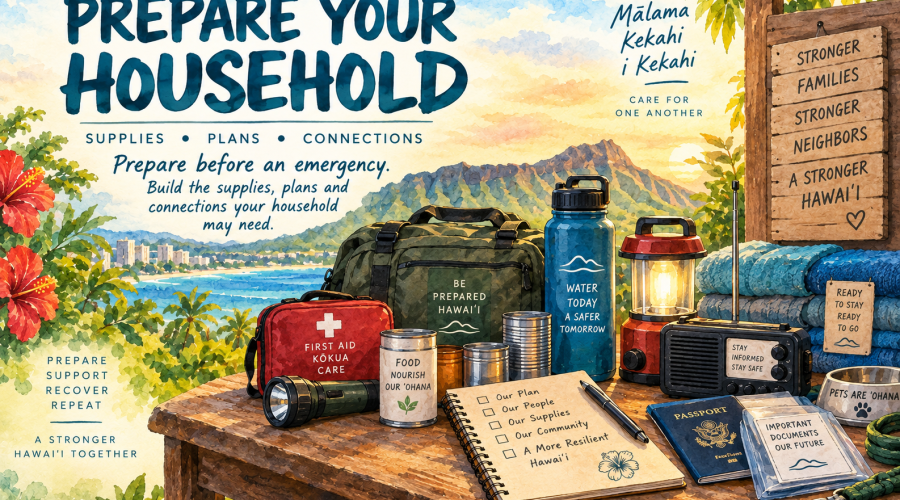
Prepare Your Household
Prepare before an emergency. Build the supplies, plans and connections your household may need.
Emergencies rarely give us the time we wish we had.
A wildfire can require you to leave quickly. A hurricane can disrupt electricity, water, transportation and supplies. Flooding, earthquakes, tsunami, severe weather and other emergencies can isolate communities or make familiar services temporarily unavailable.
Preparation does not mean predicting exactly what will happen.
It means giving your household more options when something does.
Build supplies. Make a plan. Know your neighbors. Prepare before you need to respond.
START WITH YOUR HOUSEHOLD
There is no single emergency kit or plan that works for everyone.
Your household’s needs should determine what you prepare. HI-EMA recommends considering the hazards where you live, how you will receive warnings, whether you can shelter at home, where you would evacuate, how you would communicate without power, who has additional needs, your pets, and how neighbors and relatives can help one another.
Start by asking:
Who lives in our household?
Who might be with us during an emergency?
Does anyone take essential medication?
Does anyone rely on electricity for medical, mobility or communications equipment?
Do we have infants or young children?
Do we have kūpuna who may need assistance?
Does anyone have mobility, hearing, vision, cognitive, dietary, language or other access and functional needs?
What do our pets or other animals need?
Who nearby might depend on us—and who could we depend on?
Prepare for the household you actually have.
Not somebody else’s checklist.
GET 2 WEEKS READY
In Hawaiʻi, prepare for at least 14 days.
Hawaiʻi is different from most places on the continent.
As the nation’s only island state, much of what we use arrives through long supply chains. HI-EMA warns that damage to ports and other infrastructure following a hurricane, tsunami or other major disaster could interrupt access to food and essential supplies for days or weeks.
That is why Hawaiʻi’s preparedness standard is:
2 WEEKS READY
Work toward having enough essential supplies for your household to be self-sufficient for at least 14 days.
That may sound like a lot.
You do not need to buy everything today.
Start with what you have. Add what you can. Keep building.
WATER COMES FIRST
HI-EMA recommends storing:
1 gallon per person, per day.
For two weeks, that means:
1 person = 14 gallons
2 people = 28 gallons
4 people = 56 gallons
That water is intended for drinking, cooking and personal hygiene.
Remember additional needs for:
Pets
Infant formula or special diets
Medical needs
Hot conditions
Cleaning and sanitation
Store water appropriately and rotate it according to the container or manufacturer’s recommendations.
If storing the full amount isn’t practical today, don’t let that stop you from starting.
Some water is better than none.
Build toward the goal.
BUILD A 2-WEEK FOOD SUPPLY
Choose shelf-stable food your household will actually eat.
Prioritize foods that require little refrigeration and can be prepared with minimal water, cooking or electricity.
Consider:
Canned foods
Shelf-stable proteins
Rice and other staples appropriate to your household
Crackers and dry foods
Nut or seed butters
Shelf-stable milk
High-energy foods
Infant food or formula
Foods required for medical or dietary needs
Comfort foods
Pet food
HI-EMA specifically recommends taking advantage of sales and gradually adding shelf-stable foods to your pantry rather than treating preparedness as a single large purchase.
And remember one wonderfully low-tech but important item:
A manual can opener.
If your emergency food requires refrigeration, electricity or a working stove, make sure you have alternatives.
MEDICATIONS & HEALTH
An emergency may make pharmacies, clinics and transportation difficult to access.
Prepare an appropriate emergency supply of essential medications and medical supplies, consistent with your healthcare provider’s advice and what your prescription and insurance arrangements allow.
Keep a written list of:
Medications and dosages
Allergies
Medical conditions
Doctors and healthcare providers
Pharmacies
Emergency contacts
Think beyond prescriptions.
Consider:
Eyeglasses
Hearing-aid batteries
Mobility equipment
Diabetes supplies
Oxygen or respiratory equipment
Refrigerated medication
Other household-specific medical supplies
HI-EMA includes medicine among the five core elements of Hawaii’s two-week emergency supplies.
IF SOMEONE DEPENDS ON ELECTRICITY FOR MEDICAL CARE
Make the power-outage plan now.
This deserves special attention in Hawaiʻi.
The Hawaii Department of Health advises people who depend on electricity- or battery-powered medical devices to develop a power-outage plan with their healthcare provider. That plan may need to include backup power and even temporary relocation if sufficient backup power will not be available.
Consider:
How long will the equipment operate without grid power?
What backup batteries or power are available?
How will those batteries be recharged?
Does medication require refrigeration?
Who else knows how to operate the equipment?
Where could the person safely relocate if an outage becomes prolonged?
How will you get there?
Don’t wait for an outage to discover the answers.
LIGHT, POWER & INFORMATION
Keep more than one way to produce light, charge essential devices and receive emergency information.
Useful supplies include:
Flashlights or headlamps
Extra batteries
Portable power banks
Charging cables
Battery-powered or hand-crank AM/FM radio
NOAA Weather Radio
Keep devices and power banks charged when severe weather or another known hazard is approaching.
And keep important information on paper.
Your phone is extraordinarily useful—but it should not be your entire emergency plan.
For alerts, radio frequencies, communications outages and verified information sharing, use our Emergency Communications Guide.
SANITATION & PERSONAL NEEDS
An extended utility outage can turn everyday necessities into significant problems.
Think through what your household would need without normal water, wastewater or retail services.
Prepare for:
Soap and hand hygiene
Toilet paper
Trash bags and ties
Sanitation needs
Menstrual products
Diapers and wipes
Dental care
Personal hygiene
Household-specific specialty items
HI-EMA includes personal hygiene supplies, toilet paper and garbage bags among recommended emergency and Go Bag supplies.
FIRST AID & BASIC SAFETY
Keep an accessible first-aid kit and learn how to use what is inside it.
Also know:
Where your fire extinguisher is
How to use it
Where household utility shutoffs are
Where emergency supplies are stored
Who in the household knows first aid or CPR
A piece of equipment becomes more valuable when someone knows how to use it.
IMPORTANT DOCUMENTS
A disaster can separate you from your home, belongings and normal records.
Keep protected copies of important information such as:
Identification
Insurance policies and contact information
Medical information
Prescriptions
Property information
Emergency contacts
Pet records
Important account and policy numbers
HI-EMA recommends including identification and important documents among emergency supplies and keeping Go Bag contents protected from wet weather.
Consider secure digital backups as an additional layer.
But don’t put passwords, PINs or unnecessary sensitive information on an easily accessible emergency contact sheet.
KEEP SOME CASH
Power and communications outages can affect ATMs, credit-card terminals and electronic payment systems.
HI-EMA includes cash among recommended Go Bag supplies.
Keep a reasonable amount in small denominations based on what your household can comfortably afford and safely store.
Preparedness should increase resilience—not create financial hardship.
PREPARE TO STAY — AND PREPARE TO GO
Different emergencies require different responses.
Sometimes the safest action is staying where you are.
Sometimes it is leaving immediately.
Prepare for both.
YOUR HOME SUPPLY
Your two-week household supply helps you function through an extended disruption when remaining at home is safe.
Think:
Water • Food • Medicine • Power • Information
Those are the five core areas HI-EMA identifies for becoming 2 Weeks Ready.
YOUR GO BAG
A Go Bag is different.
It contains the essentials you can grab quickly if you need to evacuate.
HI-EMA recommends considering Go Bags at home, work and in your vehicle.
Include essentials such as:
Water
Portable food
Essential medications
First-aid supplies
Flashlight
Radio
Extra batteries
Phone charger and backup battery
Rain protection and appropriate clothing
Sanitation supplies
Cash
Copies of important documents
Necessary accessibility equipment
Infant or keiki supplies
Pet supplies
Keep it somewhere you can reach quickly.
If officials tell you to evacuate, go.
Do not delay an evacuation because you’re trying to finish packing.
Life comes before belongings.
KNOW WHERE YOU WILL GO
Don’t make your first evacuation decision while you are already under pressure.
Identify more than one possible destination.
Depending on the emergency, that could be:
A designated emergency shelter
A friend or relative’s home
A location outside the affected hazard area
Another safe destination appropriate to the situation
Choose household meeting locations in case you become separated.
Know more than one route when practical.
And remember:
The safest destination depends on the hazard.
The right action for a tsunami may be completely different from the right action for wildfire, hurricane winds, volcanic activity, flooding, or another emergency.
Know the hazards where you live and follow official instructions for the emergency you are actually facing.
MAKE AN ʻOHANA EMERGENCY PLAN
Every member of the household should know the basics.
How will we receive emergency warnings?
Where will we meet if we’re separated?
Who is our out-of-area contact?
Where could we evacuate?
How would we get there?
Who is responsible for the keiki?
Who assists anyone who needs additional help?
Who takes the pets?
What happens if we’re at work or school?
What will we do if phones don’t work?
HI-EMA recommends establishing meeting places, planning how family members will communicate without power, considering plans at work and school, and making sure neighbors and relatives know your plan.
Put your plan on paper.
Make sure keiki understand the portions appropriate for their age.
Practice it occasionally.
Update it when circumstances change.
PREPARE YOUR VEHICLE
Your vehicle may become an important part of an evacuation or communications plan.
Keep useful emergency supplies in it.
Consider:
Water
Basic first aid
Phone charging equipment
Flashlight
Walking shoes
Local map
Small emergency food supply
Other essentials appropriate to your household
HI-EMA recommends vehicle emergency kits and Go Bags for the car.
When a known hazard is approaching, don’t unnecessarily allow your vehicle’s fuel or electric charge to become critically low.
And never enter a flooded roadway simply because you’re trying to evacuate or return home.
PLAN FOR YOUR PETS
If they are part of your household, they are part of your emergency plan.
HI-EMA recommends preparing two weeks of food and water for pets, along with medication, hygiene and comfort needs.
Prepare:
Food
Water
Bowls
Medications
Leash or harness
Carrier appropriate to the animal
Waste-management supplies
Identification
Veterinary information
Recent photograph
Comfort items when practical
Know where your animals could go if you evacuate.
Do not assume every emergency shelter or temporary accommodation can accept every animal.
Prepare for them before you have to leave.
PREPARE FOR ACCESS & FUNCTIONAL NEEDS
Preparedness needs to work for the people who will actually use the plan.
Depending on your household, consider:
Accessible transportation
Mobility equipment
Communication devices
Hearing-aid batteries
Service-animal supplies
Refrigerated medication
Backup power
Accessible evacuation assistance
Written instructions for caregivers
A network of people who understand the person’s needs
If someone depends on another person for essential assistance, try not to make that one person the entire backup plan.
Build redundancy into the human side of preparedness too.
KNOW YOUR NEIGHBORS
Emergency preparedness does not stop at your front door.
Know who lives nearby.
Who is a kūpuna living alone?
Who may have mobility or medical needs?
Who has young children?
Who might not receive digital alerts?
Who has useful skills or equipment?
Who could you safely help?
Who might notice if you need help?
HI-EMA specifically encourages households to consider how neighbors and relatives can help one another and recommends neighborhood communication networks as part of family planning.
This isn’t about taking responsibility for everyone.
It’s about creating relationships before an emergency makes those relationships essential.
A prepared household is stronger. A connected neighborhood is stronger still.
DON’T WAIT FOR THE WARNING
Some emergencies provide days of notice.
Others provide minutes.
A hurricane may give you time to strengthen preparations.
An earthquake does not wait for you to shop.
A fast-moving wildfire may not give you time to pack.
A locally generated tsunami may demand immediate action.
Preparedness works because the basics are already there before the emergency begins.
When advance warning does exist, use that time to check and strengthen your preparations—not start everything from zero.
PREPAREDNESS ON A BUDGET
Preparedness is not a shopping contest.
A household should not have to choose between paying today’s essential bills and buying an elaborate collection of emergency products.
Start with actions that cost little or nothing.
Write your plan.
Learn the hazards around your home.
Choose meeting locations.
Write down important phone numbers.
Identify evacuation routes.
Talk with your neighbors.
Gather useful items you already own.
Then build supplies gradually.
HI-EMA itself recommends using sales and adding a little shelf-stable food to the pantry during normal shopping trips.
One extra item.
Then another.
A little more water.
Fresh batteries.
A flashlight when you can.
A power bank when the budget permits.
Preparedness is a process, not a shopping spree.
Do what you can. Build from there.
STORE IT • CHECK IT • USE IT • REPLACE IT
Don’t build an emergency supply and forget about it for ten years.
Periodically check:
Food
Stored water
Medications and medical supplies
Batteries
Power banks
Flashlights
Radios
Clothing and shoes for growing keiki
Pet supplies
Contact information
Important documents
HI-EMA recommends treating preparedness like other routine household maintenance—checking the pantry, updating phone numbers and charging backup power—and rotating, consuming and replenishing emergency supplies over time.
Your emergency supplies should be a living household resource.
THE 15-MINUTE HOUSEHOLD PREPAREDNESS CHECK
You do not need to finish everything today.
Start here.
☐ Sign up for official emergency alerts
☐ Know the hazards where you live
☐ Choose household meeting locations
☐ Choose an out-of-area contact
☐ Write important contacts on paper
☐ Start or check your emergency water supply
☐ Start or check your emergency food supply
☐ Identify essential medications and medical needs
☐ Find your flashlights and check the batteries
☐ Charge portable power banks
☐ Make sure you have a battery-powered or hand-crank radio
☐ Start or check your Go Bags
☐ Make a plan for pets
☐ Identify anyone who may need evacuation assistance
☐ Know where you could go
☐ Talk to at least one neighbor
Then keep building until your household is:
2 WEEKS READY.
ONE PRINCIPLE TO REMEMBER
You don’t need to predict the emergency. You need options when it happens.
Water gives you options.
Food gives you options.
A Go Bag gives you options.
Backup power gives you options.
A plan gives you options.
Reliable information gives you options.
Knowing where to go gives you options.
Knowing your neighbors gives you options.
And preparation completed before an emergency gives your household something especially valuable when circumstances become uncertain:
Time to make better decisions.
PREPARE • SUPPORT • RECOVER • REPEAT
Emergency Stewardship begins before the emergency.
Prepare your household.
Help your ʻohana prepare.
Know your neighbors.
Learn where official information comes from.
Build what you can today, and keep building over time.
And when you’re able, help strengthen the preparedness of the community around you.
A stronger Hawaiʻi begins with prepared and connected communities.
Mālama kekahi i kekahi — care for one another.
OFFICIAL PREPAREDNESS RESOURCES
HI-EMA — 2 Weeks Ready in Hawaiʻi
Hawaiʻi Department of Health — Preparing for Power Outages with Electric Medical Devices
Support Local Hawaii is not an emergency response agency. This guide is for preparedness and public education. During an emergency, follow instructions issued by county Civil Defense/emergency management, emergency services, first responders and other appropriate authorities.
Emergency guidance, shelter arrangements and local procedures can change. Review your household plan and official preparedness information periodically.
Support Local Hawaii • Emergency Stewardship
PREPARE • SUPPORT • RECOVER • REPEAT