Lāʻau Lapaʻau: Honoring a Living Hawaiian Healing Tradition
Lāʻau lapaʻau is a Native Hawaiian healing tradition carried through generations of knowledge, practice, relationship, and responsibility.
It is sometimes described simply as “Hawaiian herbal medicine.” Plants and their preparation are important, but that description alone can leave out much of what makes the practice meaningful. Lāʻau lapaʻau exists within a broader Hawaiian understanding of health and relationship—one that can include the physical, spiritual, familial, environmental, and other dimensions of well-being.
For those of us who are not practitioners or cultural knowledge holders, approaching lāʻau lapaʻau begins not with asking how to practice it ourselves, but with listening, learning respectfully, and recognizing the people who continue to carry this ʻike.
More Than a List of Medicinal Plants
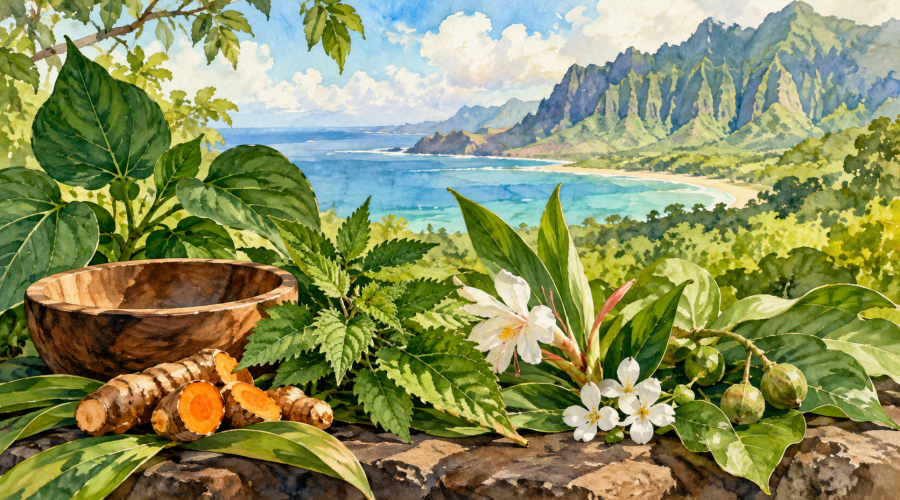
The Hawaiian word lāʻau can refer to plants, trees, wood, and medicine, while lapaʻau relates to healing or treatment. Today, institutions including the University of Hawaiʻi and Waimānalo Health Center describe lāʻau lapaʻau as Hawaiian herbal or medicinal healing.
But reducing lāʻau lapaʻau to a collection of plants and their uses can separate the medicine from the relationships, knowledge, and responsibilities surrounding it.
Native Hawaiian healing traditions developed through generations of observation, experience, teaching, and relationship with ʻāina. Historical accounts document sophisticated knowledge concerning the identification, cultivation, gathering, preparation, and use of plants. Some traditions also involve pule and other practices whose meaning and protocols belong within appropriate cultural and practitioner contexts.
Knowledge may differ among practitioners, teachers, families, lineages, and places. Not everything is intended to be generalized, published, or practiced without guidance.
That distinction matters.
A plant growing in Hawaiʻi is not simply a “natural remedy,” and reading about a historical medicinal use is not the same as receiving the knowledge, preparation, context, or responsibility needed to use it safely or appropriately.
A Tradition With a Long History
Lāʻau lapaʻau is not a rediscovered wellness trend. Its history reaches far beyond contemporary interest in herbal medicine.
Native Hawaiian knowledge holders developed extensive understandings of health and healing long before Western medicine became established in Hawaiʻi. Hawaiian-language records also preserve accounts of medicines, illnesses, treatments, and the efforts of Hawaiians themselves to document and sustain their healing knowledge.
One important example comes from nineteenth-century Maui.
During a period of devastating population loss and disease, Hawaiian leaders and practitioners organized the ʻAhahui Lāʻau Lapaʻau in Wailuku. Their work investigated Hawaiian medical knowledge and sought ways to improve the health and survival of the Hawaiian people.
Records associated with this history provide an important reminder: the preservation of lāʻau lapaʻau was not simply about preserving plants. It was connected to the health, continuity, and self-determination of a people.
Hawaiian healing practices also faced periods of restriction and marginalization as Western systems of medicine and government gained authority in the islands. Yet the knowledge did not disappear. Practitioners, families, kūpuna, educators, and communities continued carrying and teaching it.
The continuation visible today is therefore better understood as perpetuation and restoration of a living tradition, rather than the revival of something that had vanished.
Lāʻau, ʻĀina, and Responsibility
Lāʻau lapaʻau also reminds us that health cannot always be separated neatly from the health of the places that sustain life.
Medicinal plants depend upon healthy ecosystems, suitable habitat, water, soil, cultivation, and people willing to care for them. Some plants associated with Hawaiian cultural practice are endemic or indigenous species facing ecological pressures; others were brought to Hawaiʻi by Polynesian voyagers and became deeply woven into life in the islands.
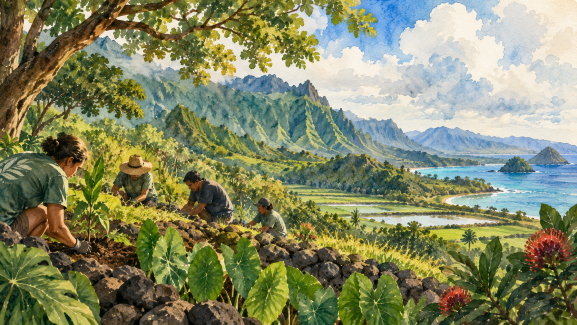
The Native Hawaiian Center of Excellence at the University of Hawaiʻi John A. Burns School of Medicine maintains a Māla Lāʻau Lapaʻau, a traditional Native Hawaiian healing garden. Its work connects cultural knowledge, education, native plants, and stewardship within a contemporary medical-school setting.
This relationship between healing and ʻāina offers an important lesson without requiring anyone to claim knowledge that is not theirs:
Caring for the sources of life is part of caring for community health.
Protecting native ecosystems, supporting culturally significant plants, respecting gathering practices, and sustaining access to ʻāina can all help create conditions in which cultural knowledge continues to live.
Lāʻau Lapaʻau Today
Lāʻau lapaʻau remains a living practice.
It is taught within Hawaiian Studies at the University of Hawaiʻi, carried by practitioners and families, supported through community initiatives, and incorporated into some contemporary health settings.
At Waimānalo Health Center, for example, the Maʻiola Services Cultural Health Program provides lāʻau lapaʻau and lomilomi within a primary-care setting. The program describes Hawaiian healing as relational and connects wellness with self, ʻohana, community, and ʻāina.
The center also offers community classes related to Hawaiian medicinal horticulture and introductory Hawaiian herbal medicine, providing an example of how people can learn through an established program rather than attempting to reconstruct practices independently.
These efforts do not require Hawaiian healing and Western medicine to be treated as interchangeable systems. They demonstrate that culturally grounded care can have a meaningful place alongside contemporary healthcare when guided by qualified practitioners and appropriate protocols.
Approaching Lāʻau Lapaʻau Respectfully
Interest in Hawaiian culture carries responsibility.
For visitors, residents, researchers, gardeners, wellness practitioners, and others who want to learn about lāʻau lapaʻau, respect begins with recognizing that cultural knowledge is not automatically public property simply because information about it can be found online or in a book.
A thoughtful approach can include:
-
Learn from practitioners and trusted Hawaiian-led sources. When classes, talks, or educational programs are offered by recognized practitioners or cultural organizations, prioritize those opportunities.
-
Listen before attempting to practice. Learning about a tradition does not automatically confer the knowledge or authority to practice or teach it.
-
Do not treat lāʻau lapaʻau as a collection of DIY remedies. Preparation, dosage, plant identification, interactions, individual health conditions, and cultural protocols all matter.
-
Respect boundaries around knowledge. Some ʻike is appropriate to share broadly; some belongs within families, practitioner relationships, or particular cultural contexts.
-
Care for the ʻāina connected to the practice. Supporting habitat restoration, native plant conservation, responsible cultivation, and appropriate stewardship helps protect more than individual plant species.
-
Give credit to knowledge holders. Whenever possible, direct attention, participation, and resources toward the practitioners, educators, organizations, and communities doing the work.
For someone simply wishing to understand more, learning respectfully is already a meaningful beginning. Participation does not require possession.
Supporting the People Who Carry the Knowledge
One of the most important things Support Local Hawaii can do is help people find those already doing this work.
Rather than positioning SLH as an authority on lāʻau lapaʻau, our kuleana is better understood as helping strengthen connections: to practitioners when they choose to be discoverable, to Hawaiian-led educational opportunities, to cultural organizations, to mālama ʻāina efforts, and to reliable resources that deepen understanding.
That also means recognizing boundaries.
Not every practitioner needs greater visibility. Not every practice should become content. Not every piece of knowledge needs to be documented online.
Sometimes stewardship means amplifying.
Sometimes it means connecting.
And sometimes it means knowing when something should remain with the people entrusted to carry it.
A Living Tradition Deserves Living Support
The continuing presence of lāʻau lapaʻau speaks to generations of people who protected, practiced, taught, restored, and carried Hawaiian knowledge forward.
Its importance cannot be reduced to whether a particular plant treats a particular condition. Lāʻau lapaʻau also carries relationships among health, ʻohana, community, culture, knowledge, and ʻāina.
For Support Local Hawaii, honoring that tradition means approaching it with humility.
We can help people discover opportunities to learn. We can support the organizations and practitioners doing the work. We can mālama the ecosystems in which culturally important plants grow. We can preserve and point toward trustworthy historical resources. And we can make room for Native Hawaiian voices to tell these stories in their own words.
The goal is not to make this knowledge ours.
It is to help create conditions in which the people carrying it can continue to practice, teach, protect, and perpetuate it for generations to come.
Learn From and Support the Work
Readers interested in learning more can begin with established Hawaiian and Hawaiʻi-based institutions, including:
Waimānalo Health Center — Maʻiola Services
The Cultural Health Program provides Native Hawaiian healing services, including lāʻau lapaʻau and lomilomi, within its healthcare setting and offers educational classes to community members.
University of Hawaiʻi John A. Burns School of Medicine — Native Hawaiian Center of Excellence
The Center stewards a Māla Lāʻau Lapaʻau and provides educational resources concerning selected plants, Native Hawaiian health, and healing traditions.
University of Hawaiʻi — Hawaiian Studies
University courses and educational programs provide opportunities for structured study of Hawaiian medicinal plants and the philosophies and traditions surrounding their use.
Office of Hawaiian Affairs
OHA has supported Native Hawaiian traditional healing initiatives and community organizations working to perpetuate Hawaiian health and cultural practices.
Whenever possible, learn directly from the people and organizations carrying the work and follow the protocols and boundaries they establish.
Health & Cultural Note
This story is intended for cultural and educational purposes. It does not provide medical advice, plant-identification guidance, prescriptions, preparation instructions, or authorization to practice lāʻau lapaʻau.
Plants—including plants traditionally used medicinally—can cause adverse effects, interact with medications, be unsafe for particular health conditions, or be harmful when incorrectly identified or prepared. For personal medical questions, consult an appropriate healthcare professional. For guidance concerning lāʻau lapaʻau, seek qualified practitioners and culturally appropriate sources.
Support Local Hawaii is not a cultural authority or practitioner of lāʻau lapaʻau. We share this story to support respectful understanding and connection to those carrying this knowledge.
A Living Story
Support Local Hawaii treats our stories as living. No single article can hold every perspective, memory, source, or piece of knowledge connected to a cultural practice or history.
We especially welcome guidance from Native Hawaiian cultural practitioners, lāʻau lapaʻau practitioners, kūpuna, educators, researchers, and community members with knowledge relevant to this story. If something needs correction, greater context, different framing, or should not be included, we welcome that guidance.
When appropriate, we will continue strengthening this story as knowledge, sources, perspectives, and practitioner guidance are shared.
Our goal is not to have the final word, nor to speak in place of those who carry the ʻike. It is to help people find trustworthy pathways toward learning, support the people and places sustaining the practice, and steward what we share with care, humility, and respect.