Aloha in Action: How Hawaiʻi Island Came Together in the Wake of Lala
From 24 community distribution points and tens of thousands of meals to emergency cash assistance, medical referrals, pet support and neighbors clearing roads together, the response to Lala is showing what Emergency Stewardship looks like when Hawaiʻi acts as one.
When disaster strikes Hawaiʻi, the story is never only about the storm.
It is also about what happens next.
It is the story of the people who open a community center when their neighbors need water. The volunteer who picks up a chainsaw. The nonprofit connecting a family with emergency assistance. The organization preparing thousands of meals. The local business washing storm-damaged clothing.
It is people sharing what they have, organizations doing what they do best, and communities taking care of one another.
In the aftermath of Lala, that story is unfolding across Hawaiʻi Island on an extraordinary scale.
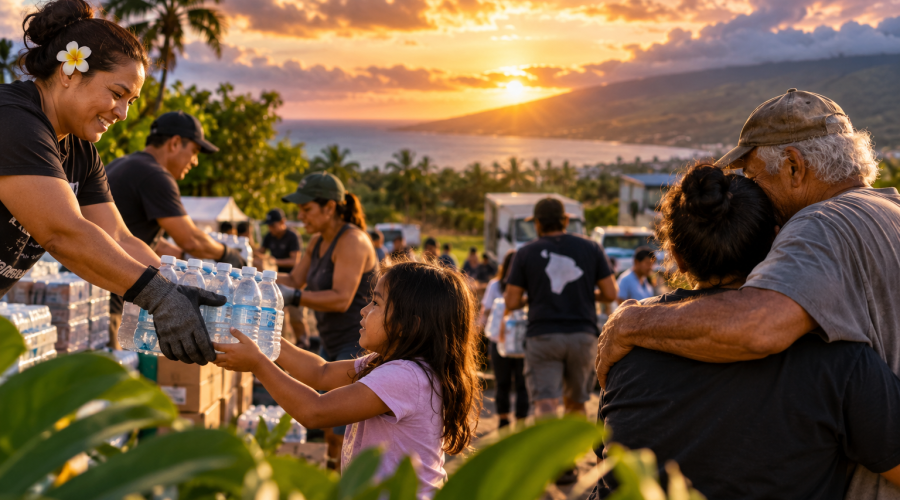
Within just 24 hours of impact, 11 Points of Distribution, or PODs, were operating across the island. Over the following 13 days, the network expanded to 24 PODs supporting 130 distributions, with nine donation centers helping coordinate supplies according to needs being reported directly from affected communities.
Behind those numbers are thousands of individual acts of service.
And together, they offer a powerful example of what we call Emergency Stewardship.
Thousands of Families. One Connected Response.
The scale of what Hawaiʻi Island communities have accomplished together is remarkable.
Through the coordinated response network, communities received:
-
- 77,320 pounds of ice
-
- 10,531 cases of water
-
- 2,492 cases of humanitarian daily rations
-
- 837 gallons of propane
-
- 2,835 gallons of gasoline
-
- 8,000 pounds of food supplies for people and pets
But emergency response is about more than moving supplies.
It begins with understanding what people actually need.
Vibrant Hawaiʻi has received 2,363 Requests for Assistance representing more than 8,000 people affected by Lala.
Among the people represented in those requests, 40% are children under 18, 16% are kūpuna age 65 or older, and 16% are Native Hawaiian.
The requests tell the human story behind the emergency:
1,859 households requesting food replacement.
611 pet- and animal-related needs.
574 requests for cleanup kits.
494 replacement clothing needs.
295 requests for chainsaw assistance.
117 requests for medical support.
Instead of those needs remaining isolated in individual homes and communities, Vibrant Hawaiʻi’s disaster case management system has helped create a shared picture of what families are experiencing — allowing organizations, volunteers and resources to be connected with the places they are needed.
That connection is at the heart of Emergency Stewardship.
53,000+ Meals — Made Possible by Organizations Stepping Forward
Food quickly became one of the largest needs following Lala.
World Central Kitchen provided 46,663 meals.
In Kaʻū, Kaukau 4 Keiki partners provided another 6,500 meals for keiki.
Together, that represents more than 53,000 meals provided through just these two efforts.
At the same time, Vibrant Hawaii distributed $443,800 in immediate cash assistance to 1,757 households, putting resources directly into the hands of families who knew best what they needed.
Another $15,000 in Goodwill vouchers helped residents replace clothing damaged or lost during the storm.
This is what a connected response can look like.
One organization doesn’t need to do everything.
It needs to do its part — and be connected to others doing theirs.
Caring for the Needs That Can Easily Be Overlooked
Some of the most important emergency needs aren’t always the most visible.
More than 100 medical referrals were directed to Healthy Mothers Healthy Babies, helping connect residents with health support.
When families reported hundreds of needs involving pets and animals, Hawaiʻi Animal Kuleana Alliance stepped forward, accepting 448 pet-related referrals, with its response supported in part by a $10,000 grant from Vibrant Hawaiʻi.
Nearly 500 cleanup-kit referrals are being addressed in partnership with The Salvation Army, supported by a $50,000 grant.
For families unable to remain in their homes, Catholic Charities has been helping with temporary housing placements through its Airbnb program.
And sometimes stewardship looks wonderfully simple.
People had clothing damaged by the storm.
The Laundry Nook washed 100 pounds of laundry.
A washing machine isn’t normally something we think of as disaster-response infrastructure.
But when someone has just experienced a storm, prolonged power outage, flooding or damage to their home, clean clothing matters.
Emergency Stewardship isn’t defined by the size of an action.
It is defined by recognizing a need and using what you have to help meet it.
The Chainsaws Were Ready Before the Storm Arrived
One of the most important lessons from the Lala response actually began long before Lala.
Hawaiʻi Island communities had already been investing in local emergency preparedness and training.
When the storm passed, that investment immediately became response capacity.
Community chainsaw teams activated across the island, including responders connected with:
Volcano Emergency Response Team
These weren’t simply names added to a response plan after disaster struck.
People had been trained.
Relationships had already been established.
Community capacity already existed.
So when roads and properties needed to be cleared, people were able to move into action.
Team Rubicon has also been coordinating its Hawaiʻi Island response with organizations including Vibrant Hawaiʻi, the American Red Cross, Hawaiʻi County Civil Defense and local communities.
This is one of the clearest lessons Lala can teach all of us:
Resilience is built before the emergency.
Hundreds of Volunteers. Dozens of Community-Led Responses.
Across Hawaiʻi Island, hundreds of community volunteers have stepped forward.
Some brought equipment.
Some transported supplies.
Some prepared meals.
Some cleared debris.
Some staffed distribution sites.
Some shared information.
Some simply showed up and asked:
What do you need?
Vibrant Hawaiʻi has helped support this grassroots response through an existing civic grant initiative. In just two weeks, 45 grant requests totaling $29,300 were funded to help community-led efforts continue their work.
And the response is still growing into recovery.
Twenty-nine partners are now supporting residents with needs including financial assistance, replacement of important documents, insurance claims and denial advocacy, health services, rebuilding navigation and financial assistance for farmers.
To date, Vibrant Hawaiʻi reports investing more than $600,000 in Lala response and recovery efforts.
The emergency may change.
The work continues.
This Is Emergency Stewardship
At Support Local Hawaii, we created the Hawaiʻi Emergency Stewardship page around a simple belief:
During Hawaii’s most difficult moments, people should be able to discover the organizations, resources and community members already stepping forward to help.
Emergency Stewardship doesn’t replace Civil Defense, first responders, government agencies or official emergency information.
It strengthens the connections surrounding them.
And the response to Lala demonstrates why those connections matter.
A household reports a need.
Someone helps make that need visible.
An organization has the ability to respond.
A funder helps provide resources.
A community hub knows the neighborhood.
A volunteer brings their hands.
A business offers what it has.
A nonprofit brings specialized expertise.
And something that no single organization could accomplish alone becomes possible through collective action.
That is stewardship.
Shining a Light on Those Leading Through Action
Over the coming days and weeks, Support Local Hawaii will use our Emergency Stewardship Hub to shine a light on the nonprofits, community organizations, businesses, volunteers and partners helping Hawaiʻi recover.
Not simply because they deserve recognition.
They do.
But because visibility strengthens response.
When people know who is doing the work, they can support them.
When communities know where resources exist, they can find them.
When volunteers know where their skills are needed, they can contribute.
When organizations can discover one another, collaboration becomes easier.
And when we document what worked, Hawaiʻi becomes better prepared for whatever comes next.
The response to Lala is showing us that resilience isn’t located in one organization.
It lives in relationships.
It lives in preparation.
It lives in communities that know one another.
It lives in people willing to share what they have.
And it lives in the thousands of decisions — large and small — to care for someone else.
Recovery Is the Next Chapter
The immediate emergency response may eventually wind down.
Recovery will not.
Families will continue rebuilding.
Farmers and ranchers will continue assessing losses.
Homes will need repairs.
Organizations will continue helping households navigate assistance.
Communities will continue cleaning up.
And some impacts won’t become fully visible for weeks or months.
Support Local Hawaii will continue expanding the Emergency Stewardship Hub throughout that journey — helping connect Hawaiʻi with trusted organizations, community resources, opportunities to volunteer, ways to give and stories of the people doing the work.
Because after an emergency, one of the most important questions we can ask isn’t only:
What happened?
It is:
Who is helping — and how can we help them?
To every nonprofit, community organization, local business, responder, donor, volunteer and neighbor who has stepped forward:
Mahalo for putting Aloha into action.
This is Hawaiʻi caring for Hawaiʻi.
This is community resilience.
This is Emergency Stewardship.
Help Hawaiʻi Island Recover
Hawaiʻi Island’s recovery from Lala is ongoing.
Visit the Hawai‘i Emergency Stewardship page to discover organizations responding to the emergency, community resources, ways to contribute, volunteer opportunities and continuing recovery efforts.
If your nonprofit, community organization, local business or volunteer effort is actively supporting Lala response or recovery, we also want to help make your work visible.
Together, we can help resources find needs, help communities find support, and shine a light on the people putting Aloha into action.