“Be strong, know who you are, no be shame, stand up, e ala ē.”
— Israel “IZ” Kamakawiwoʻole
Some voices entertain us.
Some voices stay with us.
And every once in a great while, a voice becomes inseparable from a place.
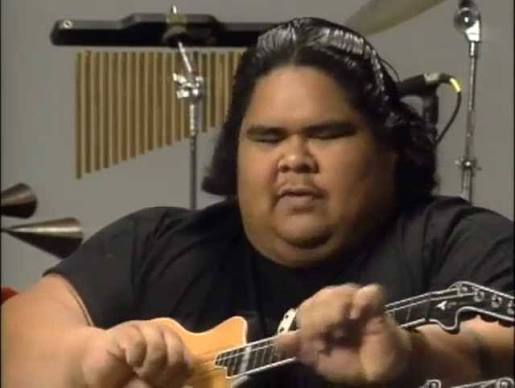
For Hawaiʻi, one of those voices belongs to Israel Kaʻanoʻi Kamakawiwoʻole.
IZ. Bruddah IZ.
A Native Hawaiian musician whose voice traveled farther than he could have imagined, introducing generations around the world to something they may not have known how to name — but could somehow feel.
Aloha. Longing. Joy. Loss. Home. And Hawaiʻi.
Today, millions of people know Israel Kamakawiwoʻole through his unforgettable medley of “Somewhere Over the Rainbow/What a Wonderful World.”
But to understand IZ only through that recording is to know just one part of his story.
Before the world discovered his voice, Hawaiʻi already knew him.
He was a son of Hawaiʻi.
A musician shaped by ʻohana, Hawaiian music and the Waiʻanae Coast.
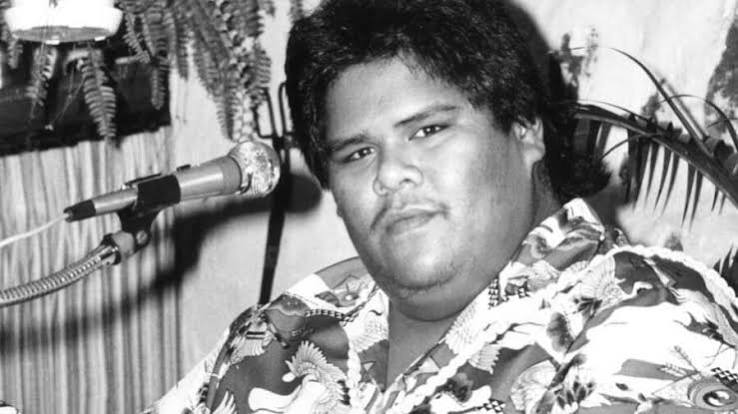
A member of the legendary Makaha Sons of Niʻihau.
A voice for Hawaiian identity.
A man who could sing gently enough to quiet a room and strongly enough to ask what Hawaiʻi had become.
And although IZ left this world far too soon, his voice never really left.
It continues to cross oceans.
It continues to introduce people to Hawaiʻi.
It continues to bring Hawaiians home to memory, identity and place.
For that enduring contribution, Support Local Hawaii is honored to recognize Israel “IZ” Kamakawiwoʻole as a Legacy Steward of Hawaiʻi.
What Is a Legacy Steward?
A Steward serves Hawaiʻi through their actions.
A Legacy Steward is someone whose lifetime of work continues serving Hawaiʻi even after they are gone.
Their influence remains.
Their knowledge continues to be shared.
Their music continues to be heard.
Their example continues to inspire.
Their contribution becomes part of what future generations inherit.
Legacy Steward recognition is not about fame.
It is about what remains because someone was here.
By that measure, IZ’s legacy is extraordinary.
Born in Hawaiʻi
Israel Kaʻanoʻi Kamakawiwoʻole was born in Honolulu on May 20, 1959.
Music surrounded him from childhood.
His parents worked at Steamboats in Waikīkī, placing young Israel around some of Hawaiʻi’s great musicians. As a boy, he encountered artists including Gabby Pahinui and the Sons of Hawaiʻi and was sometimes invited onstage with his ʻukulele.
But another place would profoundly shape the musician and Hawaiian he became.
Waiʻanae.
After his family moved to Oʻahu’s Waiʻanae Coast, Israel’s musical journey became intertwined with a group that would become part of Hawaiian music history.
The Makaha Sons of Niʻihau
As a teenager, Israel helped form what became the Makaha Sons of Niʻihau.
The group emerged during an important period in modern Hawaiʻi.
Across the islands, Hawaiian people were reclaiming and strengthening relationships with language, music, hula, voyaging, history, ʻāina and identity.
Music became one of the powerful expressions of that movement.
The Makaha Sons of Niʻihau became an important voice within it.
Over the course of their career, the group recorded 21 albums, earned numerous Nā Hōkū Hanohano Awards and helped shape contemporary Hawaiian music.
Their work connected generations.
Traditional sounds and mele were not relics of another time.
They were alive.
They belonged in the present.
They could be carried forward.
And among those voices was the unmistakable sound of IZ.
Finding His Own Voice
In 1993, after years with the Makaha Sons of Niʻihau, Israel began a new chapter as a solo artist.
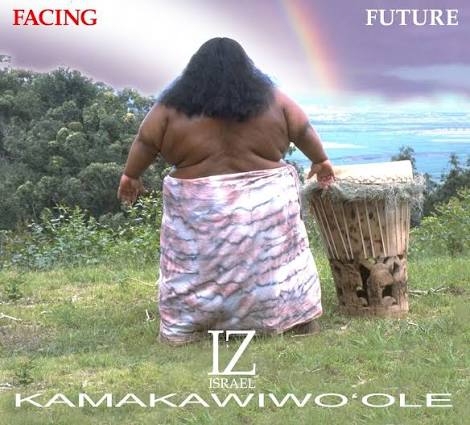
Working with producer Jon de Mello and Mountain Apple Company, IZ released Facing Future.
The album would become historic.
Facing Future became the best-selling Hawaiian music album in the world.
In 2002, it became the first recording released by a Hawaiian record label to receive RIAA Gold certification.
It later went Platinum.
But sales numbers alone cannot explain why the album endured.
People connected with IZ.
There was extraordinary gentleness in his voice.
But there was also conviction.
Humor. Pain. Pride. Spirituality.
And an unmistakable connection to Hawaiʻi.
More Than “Over the Rainbow”
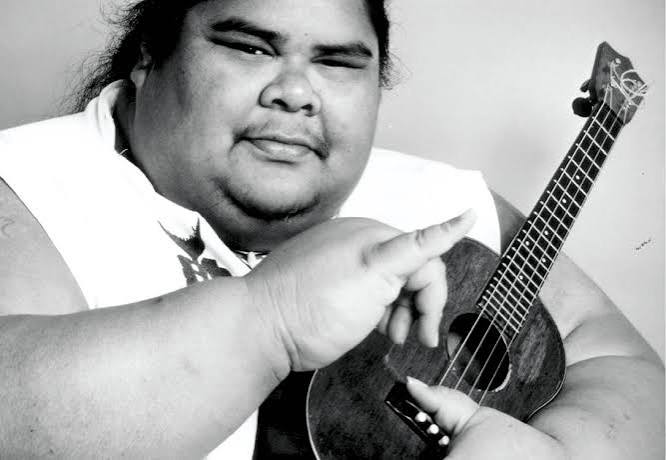
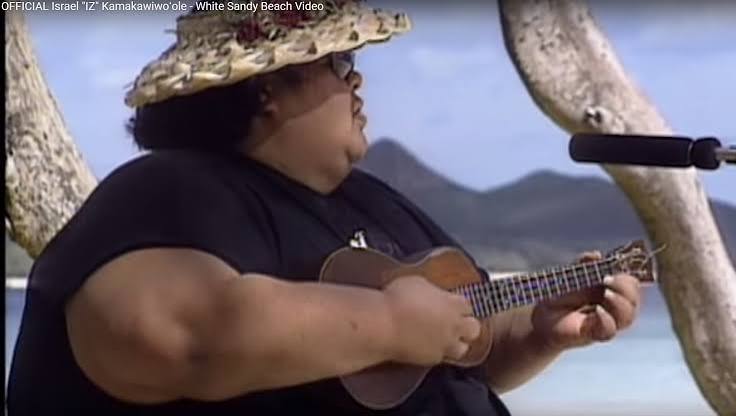
For much of the world, the first encounter with IZ is a quiet ʻukulele.
Then comes that voice.
“Somewhere Over the Rainbow/What a Wonderful World.”
The recording has traveled almost everywhere.
Across movies. Television. Weddings. Memorials. Celebrations. Hospitals. Homes.
And millions upon millions of headphones and speakers around the world.
Its simplicity is part of its power.
One man. One ʻukulele. One voice.
But there is something important for visitors discovering IZ through that song to understand:
There is much more to hear.
Listen deeper.
Listen to Facing Future.
Listen to E Ala E.
Listen to N Dis Life.
Listen to his recordings with the Makaha Sons of Niʻihau.
Listen to the Hawaiian mele.
Listen to the words.
Listen to what he was saying about Hawaiʻi.
Because the song that introduced the world to IZ can also become a doorway into understanding the Hawaiʻi he loved.
Hawaiʻi ʻ78
Perhaps nowhere is the deeper side of IZ’s legacy clearer than “Hawaiʻi ʻ78.”
The song asks listeners to imagine Hawaii’s aliʻi returning and seeing what had become of their islands.
What would they think?
What would they feel?
What had happened to the land?
To the people?
To Hawaiʻi?
Through IZ’s voice, those questions became difficult to ignore.
This was not Hawaiʻi packaged as paradise.
It was Hawaiʻi looking at itself.
A Hawaiʻi carrying memory.
A Hawaiʻi asking what had been lost.
A Hawaiʻi asking what should be protected.
And a Hawaiian voice reminding people that love for place also carries responsibility.
That is Aloha ʻĀina.
Not simply loving Hawaiʻi because it is beautiful.
Loving Hawaiʻi enough to care what happens to it.
E Ala Ē
IZ’s music could comfort.
But it could also awaken.
E ala ē. Rise. Wake up. Stand.
Know who you are.
Those ideas run through the legacy he left behind.
IZ spoke openly and proudly about being Hawaiian.
At a time when Hawaiʻi was continuing to reckon with colonization, cultural loss, political history and Native Hawaiian rights, his enormous visibility gave Hawaiian identity a powerful public voice.
He did not need to become less Hawaiian to reach the world.
He reached the world as a Hawaiian.
That distinction matters.
Because every person who discovered IZ encountered a Hawaiian name.
A Hawaiian face. An ʻukulele. Hawaiian mele. Hawaiian places.
And, if they listened beyond the most famous recording, Hawaiian history, identity and questions about the future of Hawaiʻi.
The Night the Song Was Born
The recording that would eventually carry IZ around the world began almost impossibly simply.
In 1988, recording engineer Milan Bertosa received a late-night call.
Israel wanted to record something.
It was around three in the morning.
He arrived at the Honolulu studio with his ʻukulele.
The microphones were set.
The tape rolled.
And IZ performed the medley that would become “Somewhere Over the Rainbow/What a Wonderful World.”
One voice. One ʻukulele. One take.
Years later, producer Jon de Mello heard the recording while working on Facing Future and recognized that it belonged on the album.
The rest became music history.
But perhaps the story is meaningful precisely because nobody could manufacture what happened.
There was no enormous production.
No elaborate arrangement.
No attempt to engineer a worldwide phenomenon.
There was simply a Hawaiian musician with something to sing.
And people felt it.
Hawaiʻi Said Goodbye
Israel Kamakawiwoʻole passed away on June 26, 1997.
He was only 38 years old.
Hawaiʻi’s response revealed just how deeply he had become part of the community.
IZ was given the rare honor of lying in state at the Hawaiʻi State Capitol.
Thousands came to say goodbye.
Later, his ashes were carried aboard a traditional Hawaiian voyaging canoe and scattered at Mākua on Oʻahu’s Waiʻanae Coast.
People gathered along the shoreline.
Vehicles sounded their horns.
The mountains carried the sound back toward the ocean.
Hawaiʻi was saying farewell to one of its own.
But the story did not end there.
The World Found IZ
In many ways, IZ became even more internationally recognized after his passing.
His recordings began appearing in major films, television programs and other productions.
Meet Joe Black.
Finding Forrester.
50 First Dates.
ER.
And many more.
Decade after decade, new listeners discovered him.
Parents introduced him to children.
Films introduced him to audiences who had never heard Hawaiian music.
Streaming introduced him to another generation.
And something remarkable happened:
A recording made in Honolulu in the middle of the night became one of the world’s most recognizable interpretations of one of the world’s most recognizable songs.
But wherever that recording traveled, one name traveled with it:
Israel Kamakawiwoʻole.
A Hawaiian name.
The world learned to say it.
A Doorway Into Hawaiʻi
This may be one of the most important parts of IZ’s legacy today.
Millions of people encounter Hawaiʻi for the first time through entertainment.
Sometimes what they encounter is shallow.
Sometimes Hawaiʻi becomes scenery.
A vacation. A backdrop. A commodity.
IZ offers something different.
His music provides an opportunity to go deeper.
Someone searches for “the Hawaiian Over the Rainbow singer.”
They discover Israel Kamakawiwoʻole.
Then perhaps they discover Hawaiian music.
The Makaha Sons of Niʻihau.
The Hawaiian Renaissance.
Waiʻanae. Mākua. ʻŌlelo Hawaiʻi. Aloha ʻĀina.
Hawaiian history. Native Hawaiian voices.
And eventually they begin to understand that Hawaiʻi is not merely somewhere to visit.
Hawaiʻi is a homeland.
That journey from curiosity to understanding is precisely why cultural visibility matters.
Why Support Local Hawaii Recognizes IZ
Support Local Hawaii exists to strengthen and uplift Hawaiʻi through stewardship of our culture, communities and ecosystems.
Some people do that work with their hands.
Some teach. Some plant.
Some protect. Some organize.
Some feed families. Some preserve stories.
And some carry culture through music.
IZ did something extraordinarily difficult to measure.
He made people feel Hawaiʻi.
His voice helped perpetuate Hawaiian music.
His work reflected Hawaiian identity.
His songs carried questions of ʻāina, history and responsibility.
His success demonstrated that a Hawaiian artist could remain unmistakably Hawaiian and still reach people across the world.
And his legacy continues creating doorways through which people discover Hawaiʻi today.
That does not mean one person represents all of Hawaiian culture.
No individual could.
It means IZ contributed something enduring to it.
Something future generations inherited.
For his contribution to Hawaiian music, his pride in Hawaiian identity, his love for Hawaiʻi and the extraordinary cultural legacy his voice continues to carry around the world, Support Local Hawaii is deeply honored to recognize Israel “IZ” Kamakawiwoʻole as a Legacy Steward of Hawaiʻi.
Legacy Stewardship in Action
Hawaiian Music
- Makaha Sons of Niʻihau
Helped carry Hawaiian music through an important era of cultural resurgence and into new generations.
- Facing Future
Created a landmark recording that became the world’s best-selling Hawaiian music album.
- Hawaiian Mele
Carried Hawaiian language, stories, places and perspectives through recordings heard throughout Hawaiʻi and around the world.
Hawaiian Identity
- Pride in Being Hawaiian
IZ spoke and sang from a deeply Hawaiian sense of identity without diminishing that identity for a global audience.
- Aloha ʻĀina
Songs such as “Hawaiʻi ʻ78” invited listeners to think beyond paradise and consider responsibility to land, people and history.
- E Ala Ē
His music carried messages of awakening, courage, identity and standing for Hawaiʻi.
A Global Doorway
Millions of listeners around the world continue discovering Hawaiʻi through IZ.
Film and television placements have introduced his music to generation after generation.
An unmistakably Hawaiian name and voice became known internationally without needing to be separated from the place and culture that shaped them.
What Remains
A Legacy Steward leaves us with something.
Sometimes it is land protected from development.
Sometimes it is knowledge recorded before it disappears.
Sometimes it is an organization that continues serving.
Sometimes it is a forest planted by hands that will never sit beneath its shade.
And sometimes…
it is a voice.
A voice a grandmother remembers.
A voice a father plays for his daughter.
A voice heard at a wedding.
A voice heard while grieving.
A voice that makes someone thousands of miles away wonder:
Who is Israel Kamakawiwoʻole?
And through that question, another door to Hawaiʻi opens.
That is legacy.
Not simply being remembered.
Continuing to give after you are gone.
IZ gave Hawaiʻi his voice.
Hawaiʻi gave that voice to the world.
And the world is still listening.
Mahalo nui loa, Bruddah IZ.
For the mele.
For the laughter. For the courage. For the pride.
For reminding people to know who they are.
And for carrying a piece of Hawaiʻi farther than anyone could have known that night when you sat down with an ʻukulele and began to sing.
E ala ē. Mālama Hawaiʻi.
Know who you are. Stand for what you love.
And never be ashamed of where you come from.
Your voice remains. Your mele remains. Your aloha remains.
This is legacy. This is cultural stewardship.
This is Aloha in action — across generations.
With Aloha to Mountain Apple Company
A legacy this meaningful does not carry forward on its own.
Support Local Hawaii would also like to offer our heartfelt mahalo, aloha and respect to Mountain Apple Company and the people who have helped care for IZ’s music and legacy through the years.
There is kuleana in being entrusted with something the world treasures.
Through decades of preserving, sharing and protecting his recordings, Mountain Apple Company has helped ensure that new generations can continue to discover Bruddah IZ — not only through the song that traveled around the world, but through the deeper body of Hawaiian music he left behind.
For that care, and for their broader work carrying the voices of Hawaiʻi’s musicians across generations, we are deeply grateful.
Mahalo for mālama i ka mele.
Mahalo for helping keep the music moving forward.
And most of all, mahalo for helping ensure that when the world hears that extraordinary voice, it can continue discovering the Hawaiian man, the music, the culture and the Hawaiʻi behind it.
Remember & Discover Israel “IZ” Kamakawiwoʻole
Name: Israel Kaʻanoʻi Kamakawiwoʻole
Known As: IZ • Bruddah IZ
Born: May 20, 1959 — Honolulu, Oʻahu
Passed: June 26, 1997
Home & Cultural Connection: Oʻahu • Waiʻanae • Mākaha
Stewardship Areas: Hawaiian Music • Cultural Perpetuation • Hawaiian Identity • Aloha ʻĀina • Mele • Cultural Legacy
Support Local Hawaii Recognition: ♦ Legacy Steward
The best way to honor a cultural legacy is not simply to remember it.
Listen deeper. Learn where the music came from. Discover the people and places behind it. And continue supporting the Hawaiian musicians, cultural practitioners and community stewards carrying Hawaiʻi forward today.