Restoring ʻĀina. Growing Kalo. Growing People.
West Kauaʻi • Aloha ʻĀina • Food Sovereignty • Cultural Education • Youth Development • Workforce Training
There are many ways to teach a young person where they come from.
Kumano I Ke Ala chooses one of the oldest.
Put their hands in the ʻāina.
In West Kauaʻi, Kumano I Ke Ala—KIKA—is restoring traditional agricultural lands while cultivating something equally important: people who understand their relationship and responsibility to them.
Through loʻi kalo restoration, Native Hawaiian education, traditional food systems, workforce development, community stewardship and ʻāina-based learning, KIKA connects generations of knowledge with some of Hawaii’s most immediate needs.
Healthy ʻāina.
Local food.
Cultural knowledge.
Meaningful work.
And young people who know not only where they come from—but that they have a place in where Hawaiʻi goes next.
KIKA’s work begins with aloha ʻāina.
Their stewardship makes it tangible.
I, You, We Are ʻĀina
KIKA expresses its relationship with place through a simple statement:
“I, You, We Are ʻĀina.”
That idea reaches far beyond agriculture.
ʻĀina isn’t simply where KIKA’s programs happen.
ʻĀina is the relationship the work is designed to strengthen.
Restore a loʻi, and food can return.
Grow kalo, and ancestral knowledge has somewhere to live.
Bring a child into that place, and knowledge can move between generations.
Give a young person training, mentorship and meaningful work caring for ʻāina, and stewardship can become capability and livelihood.
Invite the community into the work, and restoration becomes collective.
ʻĀina. Food. Culture. Knowledge. People. Community.
None stands alone.
And that interconnectedness is one of the things that makes KIKA’s stewardship exceptional.
Restoring More Than Land
Since 2015, KIKA has grown its work across West Kauaʻi and beyond. Today, the organization reports stewarding 97 acres across West Kauaʻi and the North Shore of Oʻahu, including more than 50 acres of Indigenous agricultural land in West Kauaʻi.
Within those landscapes, KIKA restores traditional agricultural systems, cultivates kalo, strengthens local food production and creates places where Hawaiian knowledge can continue to be practiced rather than merely remembered.
Their restoration work also reaches native ecosystems.
In 2024, the U.S. Department of the Interior selected KIKA’s Kulāiwi Connection Project for a HŌʻIHI grant supporting restoration of native forests and food systems in Makaweli, Kauaʻi.
But acreage alone doesn’t tell this story.
Because restoring ʻāina without restoring people’s relationship to it would leave part of the work unfinished.
KIKA is doing both.
Growing Food. Carrying Knowledge.
Food sovereignty is sometimes discussed in numbers:
How much food does Hawaiʻi import?
How many acres are cultivated?
How much can we produce locally?
Those questions matter.
But KIKA’s work points toward another question:
Who will know how to grow the food?
A resilient food system requires more than crops.
It requires people who understand the ʻāina.
People who carry agricultural knowledge.
People who know the practices.
People who can teach the next person.
And young people who understand why carrying that knowledge forward matters.
KIKA’s nonprofit and social-enterprise work brings these pieces together—agricultural production supporting education, restoration and community resilience.
Because food sovereignty isn’t simply having enough food today.
It is retaining the land, knowledge, relationships and people capable of growing it again tomorrow.
Growing the Next Generation
This is where the work becomes generational.
KIKA reports engaging thousands of Hawaii’s young people through ʻāina-based education over the past decade.
In 2024 alone, more than 1,600 students and faculty participated in nearly 30 farm huakaʻi, while KIKA’s Makahiki cultural education programming has reached more than 3,000 K–12 students and faculty.
But numbers again tell only part of the story.
A student can enter the farm.
Stand in the loʻi.
Learn about Hawaiian food systems.
Encounter cultural knowledge in the place where that knowledge has meaning.
Experience environmental stewardship through participation.
A young person doesn’t merely hear the definition of mālama ʻāina.
They discover what caring for ʻāina asks of their own hands.
That is how knowledge becomes lived knowledge.
And lived knowledge can be carried forward.
From Stewardship to Livelihood
KIKA also recognizes a reality essential to Hawaii’s future:
People need ways to build lives around caring for this place.
Their workforce-development programs provide training, mentorship and paid opportunities connecting young people and community members with nature-based green employment.
The County of Kauaʻi has supported KIKA’s ʻĀina Traditional Ecological Knowledge workforce programming, including pathways designed around agricultural training, environmental restoration, employment readiness, mentorship and paid internships.
That creates a powerful progression:
Learn from ʻāina.
Learn to care for ʻāina.
Develop skills through ʻāina.
Build a future caring for ʻāina.
Culture isn’t placed behind glass.
It is practiced.
Stewardship isn’t confined to an occasional act of volunteerism.
It becomes knowledge.
Responsibility.
Capability.
Livelihood.
And eventually, something one generation can teach the next.
Laulima — Many Hands Working Together
No one restores a food system alone.
No one carries a culture alone.
No one prepares an entire generation alone.
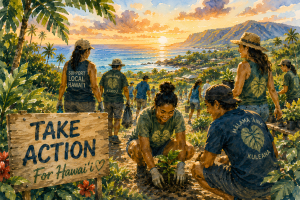
KIKA’s work creates opportunities for students, families, volunteers, educators and community members to participate—to place their own hands into the work.
That is laulima.
And there is something important about what happens when people work beside one another.
One person may arrive to pull weeds.
Another comes to learn.
Another comes carrying knowledge.
A child watches.
Someone teaches.
Something gets planted.
Something gets restored.
And somewhere in that process, community becomes stronger because people aren’t merely talking about responsibility to place.
They’re practicing it together.
Why Support Local Hawaii Recognizes KIKA as a ♦ Diamond Steward
Support Local Hawaii recognizes Kumano I Ke Ala as a ♦ Diamond Steward because its work demonstrates what happens when stewardship becomes an interconnected system rather than a single program.
For more than a decade, KIKA has worked to restore ʻāina, strengthen traditional Hawaiian food systems, bring thousands of young people into ʻāina-based learning, create workforce pathways, perpetuate ʻike through practice and invite community participation in the work. Its efforts have also earned support from institutions including the U.S. Department of the Interior, County of Kauaʻi and Ford Foundation.
But Diamond recognition isn’t awarded because an organization accumulated programs, acreage or grants.
It is awarded because of what those things reveal about the stewardship underneath them.
Healthy ʻāina supports food.
Food carries culture.
Culture carries knowledge.
Knowledge strengthens identity.
Identity strengthens people.
Skilled people can care for ʻāina.
And those people can teach the next generation.
Then the cycle begins again.
That is not simply sustainability.
That is stewardship designed to continue.
That is why KIKA is Diamond. ♦
The Foundation Comes First
KIKA shares an ʻōlelo noʻeau particularly fitting for its educational work:
ʻO ke kahua ma mua, ma hope ke kūkulu.
The foundation first, and then the building.
Perhaps there is no better way to understand what Kumano I Ke Ala is doing.
Restore the ʻāina.
Grow the food.
Carry the knowledge.
Teach the keiki.
Prepare the next generation.
Give them opportunities to practice.
Give them opportunities to lead.
And then trust them to build.
Because the greatest harvest from a loʻi isn’t measured only by what is gathered from it this season.
Some of what is being cultivated may not reveal its full value for decades.
A child who learns.
A young person who discovers purpose.
A skill that survives another generation.
A family that can feed another family.
A piece of ʻāina that becomes healthy again.
And eventually, another pair of hands capable of teaching the next pair.
That is aloha ʻāina lived.
That is laulima practiced.
That is knowledge carried forward.
That is Aloha in action.
That is stewardship. ♦
Support Kumano I Ke Ala
Volunteer alongside KIKA through community workdays and stewardship opportunities. Support its educational, agricultural and restoration work through a donation. Learn more about its programs, follow the work and discover ways to participate through Kumano I Ke Ala’s official website.