Ka Hae Hawaiʻi: Dr. Kalaniakea Wilson Shares the History of the Hawaiian Flag
The Hawaiian flag has flown through more than two centuries of Hawaii’s history.
Known as Ka Hae Hawaiʻi, the flag emerged during the reign of Kamehameha I and became a national symbol of the Hawaiian Kingdom. It continued through profound political change and remains one of the most recognizable symbols of Hawaiʻi today.
But understanding Ka Hae Hawaiʻi requires more than identifying its colors or counting its stripes.
Its history connects to Hawaiian governance, international relationships, national identity, sovereignty, and generations of people who have continued to recognize its significance.
In the featured video on this page, Dr. Kalaniakea Wilson shares the history and meaning of Ka Hae Hawaiʻi.
Rather than attempting to replace his presentation, Support Local Hawaii invites readers to begin there.
Watch: The Hawaiian Flag with Dr. Kalaniakea Wilson
The Hawaiian Flag, Kalaniakea Wilson — originally published by Big Island TV.
In the presentation, Wilson explores the origins and history of the Hawaiian flag and the relationships surrounding its development.
The video was published by Big Island TV in 2015 and has since reached a substantial audience. For those unfamiliar with the history of Ka Hae Hawaiʻi, it provides an accessible place to begin.
About Dr. Kalaniakea Wilson
Dr. Kalaniakea Wilson is a Native Hawaiian scholar, educator, Hawaiian-language speaker, and researcher whose work has included Hawaiian history, Indigenous politics, Hawaiian Kingdom history, and Hawaiian-language archival research.
His relationship with the history discussed in this video extends well beyond this particular presentation.
Wilson earned a master’s degree in Hawaiian language from the University of Hawaiʻi at Mānoa and later pursued doctoral research through UH Mānoa’s Political Science program with a focus on Indigenous Politics.
He has also spent years educating communities about Ka Hae Hawaiʻi, Lā Hoʻihoʻi Ea, Lā Kūʻokoʻa, and other dimensions of Hawaiian political and cultural history.
In 2015, the Office of Hawaiian Affairs documented Wilson presenting educational programs concerning Ka Hae Hawaiʻi at Puʻukoholā Heiau National Historic Site. University of Hawaiʻi records later described his efforts to share the history of the flag and commemorate 200 years since its emergence under Kamehameha I.
Today, published work identifies him as Kalaniakea Wilson, Ph.D.
For Support Local Hawaii, that context matters.
Rather than extracting information from Dr. Wilson’s presentation and presenting it as SLH’s expertise, we want to recognize the scholar and educator sharing the knowledge and encourage readers to listen to his presentation directly.
The Emergence of Ka Hae Hawaiʻi
Historical records place the emergence of a distinct Hawaiian national flag during the reign of Kamehameha I, around 1816.
Earlier, British colors had been used in Hawaiʻi amid developing relationships between Kamehameha and British visitors, including Captain George Vancouver.
By 1816, historical records indicate that Kamehameha’s government was using its own flag.
One account comes from Captain Alexander Adams, who entered Kamehameha’s service that year and recorded taking command of a vessel under the King’s flag.
The following year, the Hawaiian vessel Kaʻahumanu sailed to China carrying a distinct Hawaiian ensign.
Visitors to Hawaiʻi during the following decades recorded variations in the flag’s design, including different arrangements and numbers of stripes.
This is worth remembering when looking at the familiar flag today:
Ka Hae Hawaiʻi has a history of development.
The exact story of who designed its earliest form—and every motivation behind its elements—has also been the subject of differing historical accounts. Rather than presenting later interpretations as settled fact, we encourage readers to approach that history through the archival record and the work of scholars who study it.
The Flag We Recognize Today
By the reign of Kamehameha III, Kauikeaouli, the design became standardized.
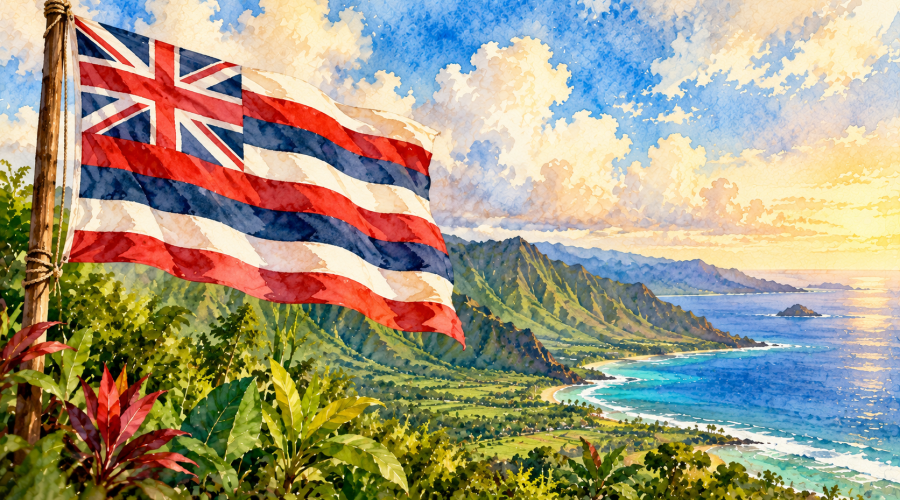
In 1845, the familiar form of Ka Hae Hawaiʻi—with eight horizontal stripes and the British Union flag in its canton—was established.
Hawaiian Kingdom records demonstrate that the flag functioned as a national symbol.
An 1846 government announcement concerning the birthday of Kamehameha III, for example, directed that the Hawaiian flag be flown from forts and ships throughout the islands as part of the observance honoring the king of an independent nation.
The flag therefore belongs within the history of Hawaiʻi not merely as a design, but as a symbol used by a functioning nineteenth-century Hawaiian government engaged with the wider world.
A Flag That Continued Through Political Change
Ka Hae Hawaiʻi did not disappear with the overthrow of the Hawaiian Kingdom government in 1893.
The flag continued through subsequent governments and eventually became the official flag of the State of Hawaiʻi.
Its meaning, however, cannot be reduced to its contemporary governmental use.
For many Native Hawaiians, Ka Hae Hawaiʻi also carries relationships to Hawaiian national history, identity, aloha ʻāina, political memory, and the continuing significance of the Hawaiian Kingdom.
Those meanings belong within a history larger than a conventional description of a state flag.
In 1990, Hawaiʻi Governor John Waiheʻe proclaimed July 31 as Lā Hae Hawaiʻi—Hawaiian Flag Day.
The date is also connected with Lā Hoʻihoʻi Ea, commemorating the restoration of Hawaiian sovereignty on July 31, 1843, following the temporary British occupation associated with Lord George Paulet.
Communities continue to commemorate that history.
Dr. Wilson himself has been involved for many years in educational programs and observances connected with Lā Hoʻihoʻi Ea and Ka Hae Hawaiʻi.
More Than a Design
It is easy to encounter Ka Hae Hawaiʻi today without knowing the history carried with it.
The flag appears at homes, community gatherings, cultural events, schools, ceremonies, protests, government buildings, businesses, and throughout everyday life in Hawaiʻi.
Different people may encounter it through different relationships and understandings.
Learning its history gives us an opportunity to look beyond the object itself.
It leads toward the Hawaiian Kingdom.
Toward Kamehameha I and the development of Hawaiian governance in a rapidly changing international world.
Toward nineteenth-century Hawaiian diplomacy.
Toward Hawaiian-language newspapers and archival records.
Toward the overthrow and the political transformations that followed.
And toward the Native Hawaiian scholars, educators, cultural practitioners, families, and communities who continue to study, teach, commemorate, and carry these histories.
Listen to the People Carrying the History
One of Support Local Hawaii’s responsibilities is knowing when our best contribution is not another explanation.
Sometimes it is a connection.
Dr. Kalaniakea Wilson has devoted years of scholarship, education, archival research, and community work to Hawaiian history and political thought.
His presentation gives readers an opportunity to hear about Ka Hae Hawaiʻi from someone whose relationship with this history extends far beyond a single video.
We encourage you to watch his presentation, continue learning through Native Hawaiian scholars and primary historical sources, and recognize the people doing the work of keeping these histories visible.
The flag has a story.
So do the people carrying its history forward.
Continue Learning
Readers interested in exploring the history of Ka Hae Hawaiʻi further can look toward Hawaiian-language newspapers, Hawaiian Kingdom government records, the University of Hawaiʻi, the Office of Hawaiian Affairs, Hawaii’s archival collections, and scholarship by Native Hawaiian historians and researchers.
Whenever possible, Support Local Hawaii encourages readers to move beyond summaries and toward the voices, records, and knowledge holders closest to the history.
About This Story
This Support Local Hawaii page originally contained the featured video with little additional context.
As part of our continuing review of older stories, we expanded the page to better recognize Dr. Kalaniakea Wilson’s scholarship, provide readers with historical context for Ka Hae Hawaiʻi, and make clear where the knowledge and expertise featured here come from.
The original video remains at the center of the story.
Our goal is not to replace Dr. Wilson’s voice with ours, but to help more people discover his work and understand why the history he shares matters.
A Living Story
Support Local Hawaii treats our stories as living. No single article can hold every perspective, memory, source, or piece of knowledge connected to a place, person, community, or history.
We welcome thoughtful contributions from those who carry knowledge of the subjects we share—especially kūpuna, cultural practitioners, lineal descendants, community members, historians, researchers, and stewards. If something is missing, needs clarification or correction, or would benefit from cultural guidance or additional context, we invite you to reach out.
When appropriate, we will continue to strengthen and update our stories as new knowledge, sources, perspectives, and guidance are shared.
Our goal is not to have the final word. It is to help preserve connections in the historical record, encourage thoughtful learning, connect people with those carrying the ʻike, and steward these stories with care, humility, and aloha.