Ahupuaʻa: Learning From a Living Hawaiian Approach to ʻĀina
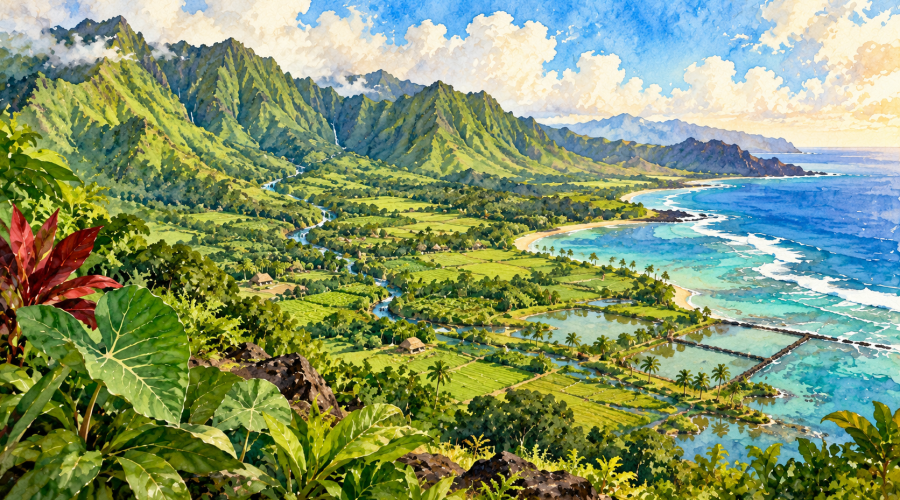
From mountain forests and streams to agricultural lands, wetlands, fishponds, shorelines, reefs, and the sea, the health of Hawaiʻi’s places is interconnected.
Native Hawaiians understood and managed these relationships through sophisticated systems of land tenure, governance, resource management, and cultural practice developed over generations.
The ahupuaʻa was an important part of that larger system.
Often described today as a division of land extending from mauka toward makai, ahupuaʻa connected people and places across different ecological zones. Their boundaries, sizes, environments, and resources varied considerably. They were places where relationships among land, water, ocean, community, governance, and responsibility could be managed together.
Today, as Hawaiʻi faces pressures including watershed degradation, invasive species, declining nearshore ecosystems, food insecurity, development, and climate change, ahupuaʻa are increasingly part of conversations about how communities care for places as interconnected systems.
But ahupuaʻa are more than a sustainability model for modern society to borrow.
They are part of a living Hawaiian cultural landscape.
Understanding them begins with recognizing the people, knowledge, relationships, rights, and responsibilities connected to these places.
What Is an Ahupuaʻa?
In traditional Hawaiian systems of land organization, islands were divided into moku, and moku were further divided into smaller land units, including ahupuaʻa.
The Hawaiian Dictionary by Mary Kawena Pukui and Samuel H. Elbert describes an ahupuaʻa as a land division usually extending from the uplands toward the sea. The name is associated with an ahu, or stone marker, where a representation or offering of a puaʻa was associated with tribute to the chief.
The familiar image of an ahupuaʻa as a neat wedge running from the top of a mountain all the way through a reef can be useful for understanding the concept, but actual ahupuaʻa were not identical.
Geography mattered.
Some encompassed multiple ecological zones. Their sizes and shapes varied, and the resources available in one place were not necessarily the same as those available in another.
People also exchanged resources and knowledge beyond individual ahupuaʻa.
Rather than thinking of each ahupuaʻa as an isolated, perfectly self-sufficient village, it is more useful to understand it as part of a larger Hawaiian system through which people, governance, resources, and relationships with place were organized.
Managing Relationships From Mauka to Makai
One reason ahupuaʻa remain so relevant to contemporary environmental conversations is the recognition that what happens in one part of a landscape affects another.
Water provides a clear example.
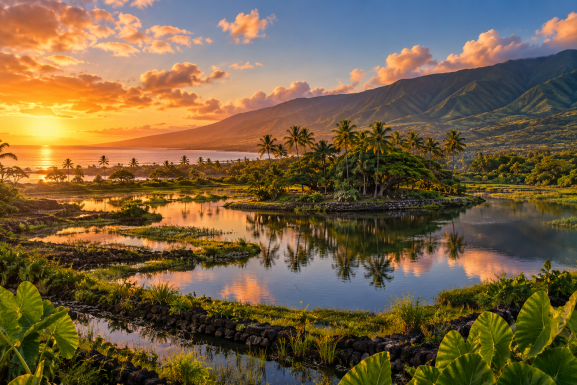
Rain falling in upland forests enters soils, groundwater, springs, and streams. Water moving through a landscape can support communities and agriculture before continuing toward wetlands, estuaries, fishponds, nearshore waters, and reefs.
Changes upstream can therefore have consequences downstream.
Modern watershed and marine science similarly recognizes these connections. Sediment, nutrients, pollutants, altered streamflow, invasive species, land development, and changes in vegetation can affect ecosystems far beyond the place where the disturbance begins.
For Native Hawaiian communities, however, these relationships were not simply ecological observations.
They existed within systems of governance, practice, knowledge, and responsibility.
Aliʻi held governing responsibilities. Konohiki managed resources and activities within ahupuaʻa. Makaʻāinana cultivated lands, gathered resources, fished, maintained systems, and sustained communities. Practices and restrictions could regulate when and how particular resources were harvested.
The system was social and political as well as ecological.
That fuller context matters when ahupuaʻa are discussed today.
Beyond the Idea of “Perfect Sustainability”
It can be tempting to describe pre-contact Hawaiʻi as a place where people lived in perfect harmony with nature and never took more than ecosystems could provide.
That framing is too simple.
Hawaiian communities were managing real populations, resource demands, environmental variability, political relationships, and changing landscapes. Resource management required knowledge, governance, labor, observation, restrictions, and adaptation.
The remarkable lesson is not that people somehow existed outside ecological limits.
It is that generations developed sophisticated ways of understanding those limits and organizing relationships around them.
Kapu could restrict access to particular resources or seasons. Water use required coordination. Agricultural and aquacultural systems were adapted to different environments. Specialized knowledge developed around particular places and resources.
Rather than romanticizing the past, we can recognize the depth of knowledge and governance required to sustain communities across Hawaiʻi’s diverse landscapes.
What Changed?
The transformation of Hawaiʻi’s land and water systems cannot be explained simply as “industrialization.”
Hawaiʻi experienced profound political, economic, demographic, ecological, and land-tenure changes following Western contact.
Disease devastated the Native Hawaiian population.
Introduced plants and animals transformed ecosystems.
Commercial agriculture altered landscapes and water systems.
Changes in land tenure, including those surrounding the Māhele, transformed relationships among people, land, property, and governance. Subsequent land transactions and dispossession separated many Native Hawaiians from ancestral lands and practices connected to them.
Urbanization, military use, infrastructure, stream diversions, invasive species, pollution, and other changes further reshaped watersheds and coastal ecosystems.
The effects differ from place to place, and their histories deserve to be understood locally.
This history matters because contemporary efforts to restore an ahupuaʻa cannot simply recreate a landscape from centuries ago.
The people, ecosystems, laws, ownership patterns, infrastructure, climate, and communities of Hawaiʻi today are different.
The question is therefore not simply:
How do we bring back the past?
A more useful question may be:
What can living Hawaiian knowledge, community leadership, and relationships with place teach us about caring for these landscapes now?
Ahupuaʻa Are Not Only History
Across Hawaiʻi, communities and organizations are already answering that question through practice.
In places including Heʻeia on Oʻahu, Hāʻena on Kauaʻi, Kaʻūpūlehu on Hawaiʻi Island, and Kawela on Molokaʻi, community stewardship demonstrates contemporary approaches to caring for interconnected lands and waters.
The work differs according to place.
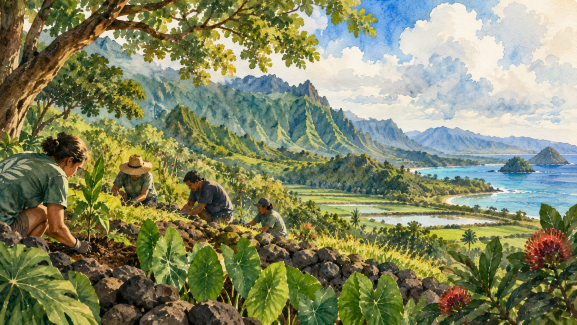
It can include restoring loʻi kalo and loko iʻa, caring for native forests, removing invasive species, restoring stream and wetland function, monitoring fisheries, perpetuating traditional and customary practices, educating young people, conducting research, and strengthening community participation in natural-resource management.
These efforts should not be flattened into a single model.
Each place has its own history.
Each community has its own relationships.
And the people who have cared for those places carry knowledge that cannot be replaced by a generic diagram of an ahupuaʻa.
Traditional and Customary Rights Continue
Ahupuaʻa also remain relevant within Hawaiʻi’s contemporary legal landscape.
Hawaiʻi law recognizes traditional and customary rights associated with Native Hawaiian practices, including particular gathering, cultivation, subsistence, cultural, and religious activities.
Water rights and access to natural resources continue to intersect with questions of Hawaiian rights, land tenure, environmental protection, development, and community stewardship.
That is another reason ahupuaʻa should not be treated simply as an ancient environmental-management technique available for anyone to adopt.
These landscapes remain connected to living communities, cultural practices, legal rights, and ongoing responsibilities.
What Ahupuaʻa Can Teach Us
For people outside these traditions, there are still important things to learn.
One is connection.
A forest cannot be managed as though the stream below it does not exist.
A stream cannot be understood without considering the lands through which it travels.
A wetland cannot be separated entirely from agriculture, groundwater, development, or the coast.
And a reef cannot always be protected solely by actions taken in the ocean.
The health of a place depends upon relationships across the whole system.
Another lesson is place.
Solutions appropriate for one watershed may not be appropriate for another. Rainfall, geology, species, agriculture, history, cultural practices, land ownership, community needs, and other conditions differ.
Good stewardship begins by learning where we are.
And another lesson is responsibility.
Healthy landscapes do not maintain themselves simply because people value sustainability. They require people willing to observe, work, cooperate, establish limits, restore damage, pass on knowledge, and remain accountable to future generations.
Supporting Ahupuaʻa Stewardship Today
For Support Local Hawaii, the goal should not be to create our own version of ahupuaʻa management.
Many people and organizations are already doing this work.
Our kuleana is better served by helping people find them, learn from them, participate when invited, and support their work.
That might mean volunteering with an ʻāina restoration organization.
It might mean supporting a loko iʻa or loʻi restoration project.
It might mean learning about the watershed where you live.
It might mean buying food from farmers caring for Hawaiʻi’s agricultural lands.
It might mean supporting organizations protecting streamflow, native forests, fisheries, or cultural practices.
And sometimes it simply means listening to the people who have cared for a place long before we arrived.
Before asking how an ahupuaʻa model can be applied somewhere else, there is another question worth asking first:
Who is already caring for this place?
That question can lead us toward the relationships that stewardship requires.
From Ahupuaʻa to a Connected Hawaiʻi
The ahupuaʻa offers more than a historical lesson about land division.
It helps illuminate something fundamental about islands:
nothing exists entirely by itself.
Forest health can affect water.
Water can affect agriculture.
Agriculture and development can affect streams.
Streams can affect fishponds and reefs.
Healthy ecosystems can support communities.
And communities willing and able to care for places can shape what remains possible for generations to come.
That interconnectedness is deeply relevant to Support Local Hawaii.
Culture, communities, ecosystems, food, farms, local economies, education, stewardship, and preparedness are not separate worlds. They continually affect one another.
Our responsibility is not to claim the ahupuaʻa system as our model or to suggest that SLH is bringing it back.
It is to recognize the knowledge already present in Hawaiʻi, support the people putting that knowledge into practice, and help more people discover meaningful ways to care for the places they call home.
The work is already happening.
Our opportunity is to strengthen the connections around it.
Learn From and Support the Work
Readers interested in understanding ahupuaʻa and contemporary place-based stewardship should prioritize Native Hawaiian-led and Hawaiʻi-based organizations, practitioners, researchers, and community initiatives.
The Office of Hawaiian Affairs provides educational resources concerning Hawaiʻi’s traditional land systems, Native Hawaiian rights, and cultural practices.
The University of Hawaiʻi maintains research and educational resources concerning ahupuaʻa, watersheds, traditional agriculture, marine ecosystems, and contemporary community stewardship.
Across the islands, community organizations are restoring loʻi, loko iʻa, forests, streams, wetlands, and nearshore ecosystems while perpetuating relationships and practices particular to their places.
Support Local Hawaii will continue working to connect these efforts through our Stewards, Projects, Gather, Take Action, Stories, and other stewardship resources.
Where possible, we encourage people to learn directly from and support those already caring for the place.
A Note About This Story
This story was originally published by Support Local Hawaii in 2024 and has since been substantially revised.
Our earlier version described ahupuaʻa too simply as completely self-sufficient communities whose residents never over-exploited resources, and framed contemporary stewardship as a need to “revive” an ancient system.
Those descriptions did not adequately represent the complexity of Hawaiian land management or the living communities, practices, rights, and organizations carrying place-based stewardship forward today.
We have revised the story to provide greater historical context, avoid romanticizing Hawaiian resource management, and better recognize the people already doing this work.
As with all of our cultural stories, we welcome correction and guidance from those with deeper knowledge and relationships to the places and traditions discussed here.
A Living Story
Support Local Hawaii treats our stories as living. No single article can hold every perspective, memory, source, or piece of knowledge connected to a place, community, or history.
We welcome thoughtful contributions from those who carry knowledge of the subjects we share—especially kūpuna, cultural practitioners, lineal descendants, community members, historians, researchers, and stewards. If something is missing, needs clarification or correction, or would benefit from cultural guidance or additional context, we invite you to reach out.
When appropriate, we will continue to strengthen and update our stories as new knowledge, sources, perspectives, and guidance are shared.
Our goal is not to have the final word. It is to help preserve the record, encourage thoughtful discussion, connect people with those carrying the ʻike, and steward these stories with care, humility, and aloha.