Hawaiʻi Has Done This Before: When Culture Guides Technology
There are moments when the past doesn’t feel very far away.
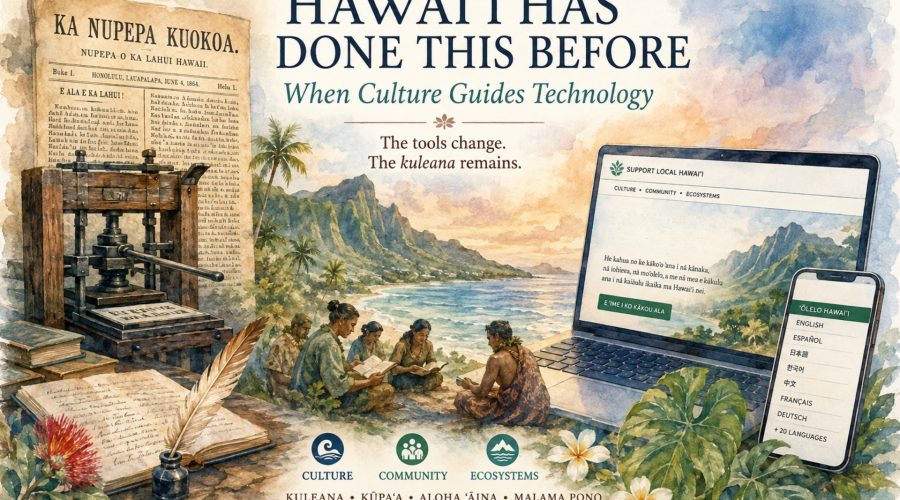
With the click of a button, the words across Support Local Hawaii transformed from English into ʻōlelo Hawaiʻi.
Navigation. Stories. Resources. Stewardship. Community. The framework we have been building together — suddenly speaking through the language of this place.
And it brought to mind something remarkable:
Hawaiʻi has done this before.
Long before websites, social media, smartphones, or artificial intelligence, another communications technology was transforming the world.
The printing press.
And Hawaiian people embraced it.
A Kingdom of Readers, Writers, and Thinkers
During the Hawaiian Kingdom, literacy spread throughout the islands with extraordinary speed.
But Hawaiians didn’t simply learn how to read and write.
They began publishing.
Hawaiian-language newspapers — nūpepa — became places where people shared news, discussed politics, recorded genealogies, preserved moʻolelo, published mele, debated ideas, documented events, communicated across islands, and engaged with a rapidly changing world.
The surviving Hawaiian-language newspaper archive contains an extraordinary body of knowledge.
Those pages tell us something important.
Hawaiians were not passive observers of technological change.
They took the tools available to them and used those tools to communicate, preserve knowledge, strengthen community, and give Hawaiʻi a voice.
That lesson feels remarkably relevant today.
We Are Living Through Another Technological Transformation
The printing press changed how information moved.
Today, the internet, cloud computing, translation technologies, artificial intelligence, and interconnected digital platforms are doing the same thing on a scale humanity has never experienced before.
Information can move around the planet almost instantly.
A story written in Hawaiʻi can be read in Tokyo.
A community resource created on Hawaiʻi Island can reach someone in Aotearoa, Europe, the Philippines, or South America.
A platform created here can be translated into multiple languages in seconds.
The technology is extraordinary.
But technology alone is not the important part.
The important question is:
What values guide it?
Technology Should Not Tell Hawaiʻi Who to Become
Too often, technological progress is framed as something communities simply have to adapt to.
A new platform arrives.
A new system arrives.
A new algorithm arrives.
And people are expected to reorganize themselves around the technology.
We believe there is another way.
Technology can adapt to people.
It can respect place.
It can strengthen relationships.
It can protect culture.
It can help communities communicate without replacing the human connections that make communities strong.
And perhaps most importantly, technology can be built with enough humility to understand that innovation did not begin with technology.
Hawaiʻi has always innovated.
The systems that allowed generations to navigate the Pacific, cultivate food, manage water, steward fisheries, understand the stars, preserve genealogy, and sustain communities required extraordinary knowledge accumulated across generations.
Technology should not erase that intelligence.
It should serve it.
Culture Comes First
There is a reason Support Local Hawaii has always placed these words together:
Culture • Community • Ecosystems
And there is a reason culture comes first.
Because without understanding the culture of a place, it is difficult to understand how to serve its community.
Without understanding the community, it is difficult to understand how to care for its ecosystems.
Technology comes afterward.
It is a tool.
A powerful one — but still a tool.
The values guiding that tool matter far more than the tool itself.
From Nūpepa to Digital Networks
The Hawaiian-language newspapers of the Kingdom and today’s digital networks belong to completely different eras.
We should never pretend otherwise.
But there is a principle connecting them that deserves our attention.
Communication technology can become a vessel for culture rather than a replacement for it.
The printing press gave Hawaiian writers another way to record and distribute their voices.
Today’s technology gives us possibilities that would once have been unimaginable.
We can connect communities across islands.
We can share emergency information rapidly.
We can help local organizations become easier to discover.
We can preserve stories.
We can connect people with opportunities to serve.
We can build digital gathering places.
And increasingly, we can allow people to experience those spaces through the languages they understand best.
That creates an enormous responsibility.
Because the question is no longer simply whether we can build these systems.
The question is what kind of systems we choose to build.
ʻŌlelo Hawaiʻi Deserves More Than Translation
Seeing a modern digital platform rendered in ʻōlelo Hawaiʻi is powerful.
But translation should never be mistaken for the destination.
Language carries worldview, history, relationships, meanings, and ways of understanding place that cannot always be transferred perfectly from one language into another.
Technology can help open the door.
People must guide what comes through it.
That means Hawaiian-language speakers, cultural practitioners, educators, kūpuna, community members, and future generations have an important role in determining how these technologies grow.
The goal should not simply be technology that can translate Hawaiʻi.
The greater opportunity is technology that can listen to Hawaiʻi.
Hawaiʻi Can Help Shape What Comes Next
The world is entering an era in which technology will increasingly influence how people communicate, learn, organize, work, respond to emergencies, and understand one another.
Hawaiʻi does not have to stand on the sidelines of that transformation.
And Hawaiʻi does not have to surrender what makes this place extraordinary in order to participate in it.
There is another possibility.
We can build technology around principles that have sustained communities here for generations:
Kuleana.
Responsibility.
Reciprocity.
Stewardship.
Relationship.
Care for place.
Care for one another.
Not technology replacing those principles.
Technology answering to them.
The Tools Change. The Kuleana Remains.
The printing press was once revolutionary technology.
Today it sits quietly inside history.
The technologies that seem extraordinary to us now will someday do the same.
But the responsibility accompanying them will remain.
What will we preserve?
What will we strengthen?
Whose voices will these systems carry?
What knowledge will we pass forward?
What kind of relationships will our technology encourage?
And what will future generations inherit from the choices we make today?
Those questions are bigger than any website.
They are bigger than any platform.
They belong to all of us.
Hawaiʻi has encountered transformative technologies before.
Hawaiian people learned them, adapted them, and used them to speak to one another and to the world.
Perhaps that history offers us some guidance now.
The tools will continue to change.
The kuleana remains.
A Living Story
Support Local Hawaii treats our stories as living. No single article can hold every perspective, memory, source, or piece of knowledge connected to a place, community, or history.
We welcome thoughtful contributions from those who carry knowledge of the subjects we share—especially kūpuna, cultural practitioners, lineal descendants, community members, historians, researchers, and stewards. If something is missing, needs clarification or correction, or would benefit from cultural guidance or additional context, we invite you to reach out.
When appropriate, we will continue to strengthen and update our stories as new knowledge, sources, perspectives, and guidance are shared.
Our goal is not to have the final word. It is to help preserve the record, encourage thoughtful discussion, connect people with those carrying the ʻike, and steward these stories with care, humility, and aloha.
Support Local Hawaii
Culture • Community • Ecosystems