Lāhainā: The Water Was Taken, the ʻĀina Was Buried, but Lele Was Never Erased
To understand what burned in Lāhainā on August 8, 2023, we have to remember what existed there before the fire, before the Territory, before any annexation claims, and before the overthrow of the Hawaiian Kingdom.
Before much of the world knew this place as Lāhainā, it was Lele.
Before Front Street.
Before Canal Street.
Before plantation water systems.
Before the Territory of Hawaiʻi.
Before the United States illegally claimed these islands as its own.
There was wai.
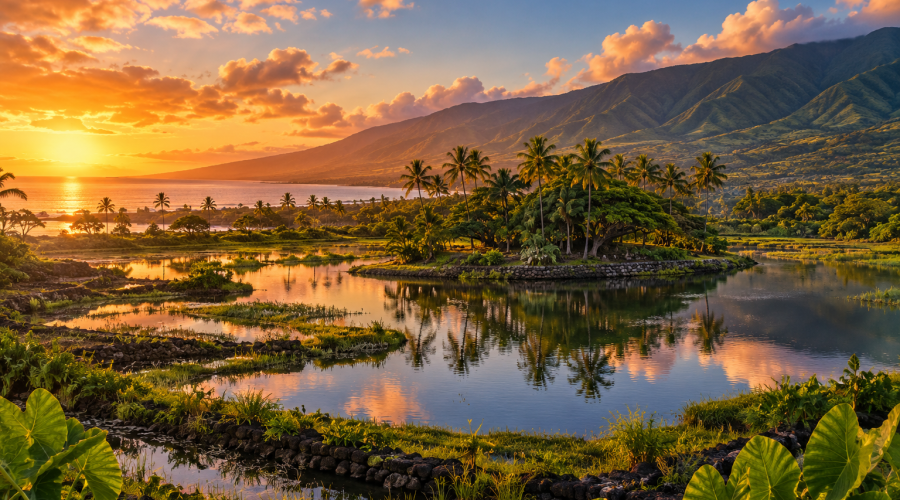
Water descended from the uplands of West Maui. Springs emerged across the lowlands. Streams, wetlands, loʻi, loko and nearshore waters formed interconnected systems supporting food, wildlife and generations of people.
This was ʻāina momona—land of abundance.
A Hawaiian-language account published in 1867 remembered Lāhainā as Lele, a place beloved by aliʻi, rich and beautiful, remembered for its waters, groves and cooling winds.
Lele was known locally to Hawaiians as, “Malu ‘ulu o Lele”, meaning “Shaded breadfruit grove of Lele”.
Another Hawaiian newspaper account, published in 1870, documented something beginning to change.
It described an “aumeume ka wai”—a struggle over water in Lāhainā.
Workers for foreign sugar interests, the account said, were taking water and leaving loʻi dry.
That was written by Hawaiians while it was happening.
Not reconstructed a century later.
Not inferred after the fire.
Recorded in their newspapers.
And those voices belong at the beginning of this story.
Mokuʻula: The Sacred Heart of Lele
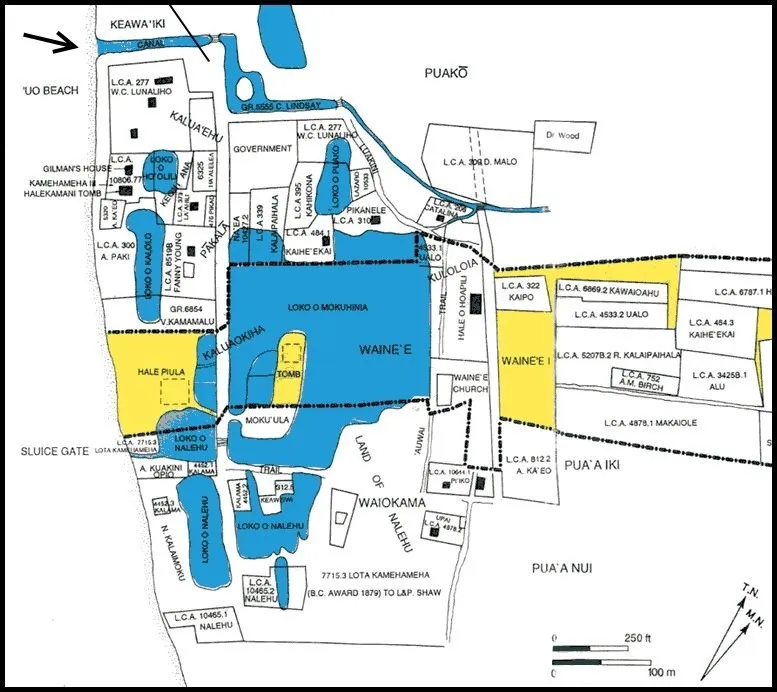
At the center of this water-rich landscape was Loko o Mokuhinia.
Within its waters was Mokuʻula.
Mokuʻula was not simply an island in a pond.
It was a wahi pana of profound genealogical, spiritual and political significance, associated with Kihawahine and generations of Maui and Hawaiian aliʻi.
It became a royal residence of Kauikeaouli, Kamehameha III, while Lāhainā served as the capital of the Hawaiian Kingdom.
Here stood a center of an independent Hawaiian nation.
Government operated here.
Diplomacy happened here.
Families lived here.
Food was cultivated here.
Knowledge was practiced here.
The relationship between people and water was lived here.
Lāhainā did not become important when outsiders discovered it.
It did not become productive when plantations arrived.
It did not become developed when streets were paved across it.
It was already a highly organized Hawaiian place.
And its abundance was inseparable from wai.
Then the Water Began to Be Taken
Commercial sugar transformed Hawaiʻi.
Sugar required enormous amounts of water.
Across the islands, plantation systems constructed ditches, tunnels and flumes that redirected water from watersheds toward cane fields. By 1920, plantation diversion systems across Hawaiʻi were moving hundreds of millions of gallons every day.
West Maui was part of that transformation.
And Hawaiians in Lāhainā were documenting the struggle decades before the overthrow.
In 1870, Ka Nupepa Kuokoa described foreign sugar interests diverting water while loʻi dried.
The record is remarkably direct.
The transformation of Lāhainā’s hydrology was not something Hawaiians failed to notice.
They were witnessing it.
They were writing about it.
They were living with its consequences.
As water feeding the lowlands diminished, Loko o Mokuhinia increasingly stagnated.
A landscape sustained by flowing freshwater was being changed.
Later authorities would increasingly describe places such as Mokuhinia not as components of a living Hawaiian cultural landscape, but as “swamps”—places to be drained, filled, reclaimed or repurposed.
Language mattered.
Once a wetland became a “swamp,” destroying it could be described as improvement.
Once filling became “reclamation,” burying a landscape could be described as progress.
But before we reach what happened to Mokuhinia, another history has to be told.
Because the government that eventually buried this landscape was not the government that had governed from Mokuʻula.
The Hawaiian Kingdom Was Overthrown
On January 17, 1893, the government of Queen Liliʻuokalani was illegally overthrown.
This was not merely a later Hawaiian interpretation of history.
The United States government’s own records document the involvement of its diplomatic and military representatives.
President Grover Cleveland’s investigation concluded that what had occurred constituted a grave wrong against the Hawaiian government.
And in 1993—one hundred years later—the United States Congress adopted Public Law 103-150.
Its title uses words that should not be forgotten:
“To acknowledge the 100th anniversary of the January 17, 1893 overthrow of the Kingdom of Hawaii, and to offer an apology to Native Hawaiians on behalf of the United States for the overthrow of the Kingdom of Hawaii.”
Congress acknowledged the historical significance of the illegal overthrow and U.S. participation in it.
The resolution also acknowledged that Native Hawaiians never directly relinquished their claims to inherent sovereignty over their national lands to the United States through the Hawaiian Kingdom or through a plebiscite or referendum.
And Congress included another crucial provision:
the resolution did not settle claims against the United States.
An apology did not resurrect the Kingdom government that had been displaced.
It did not return the lands.
It did not restore Mokuʻula.
It did not restore the waters.
And it did not erase what followed.
After the overthrow came the Republic of Hawaiʻi.
Then came the illegal “annexation” by the United States in 1898—built upon an illegal overthrow. What followed afterward does not make what happened lawful.
Then the Territory of Hawaiʻi.
That chronology matters enormously to what comes next.
Because thirteen years after the overthrow, the government administering Hawaiʻi made an extraordinary decision about Lāhainā’s canal.
March 1, 1906
There are moments when the archive needs almost no interpretation.
This is one of them.
An official notice of the Board of Health, dated March 1, 1906, records a decision made at its meeting the previous day.
Under government Garbage Regulations, locations were designated:
“as public dumping grounds for the dumping and disposition of garbage.”
One was in Wailuku.
Then comes the heading:
LAHAINA
And beneath it:
“That portion of Lahaina known as the ‘canal’…”
The notice was signed by L. E. Pinkham, President of the Board of Health, and attested by Secretary C. Charlock.
The recovered clipping identifies its publication in the Maui News on March 24, 1906.
THE DOCUMENT
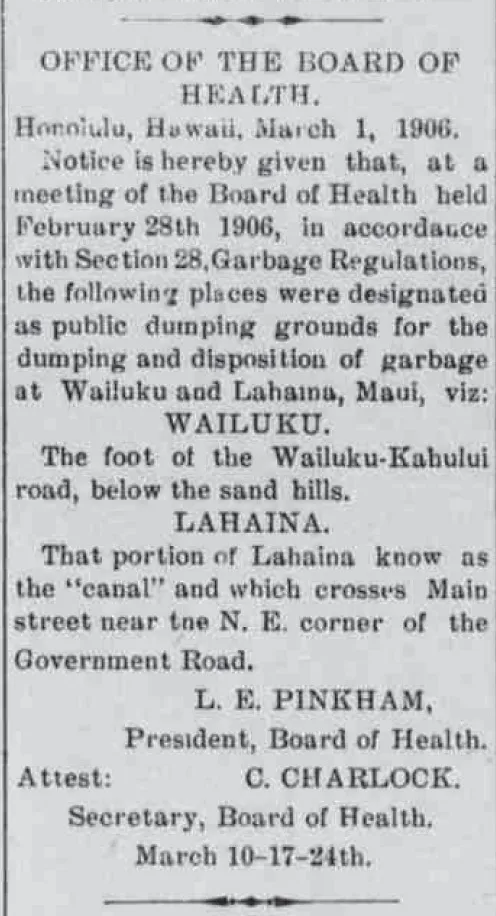
Primary source: Official Board of Health notice dated March 1, 1906, identifying a portion of Lahaina’s “canal” among designated public dumping grounds for garbage. Recovered clipping identified as published in the Maui News, March 24, 1906.
There it is. In the government’s own words.
Part of Lāhainā’s canal was officially designated as a public garbage dumping ground.
Not by Kamehameha III.
Not by the Hawaiian Kingdom that had governed from Mokuʻula.
Not as part of a Hawaiian system of mālama ʻāina.
By the government administering the Territory of Hawaiʻi after the overthrow and annexation.
That distinction belongs permanently in the history of Lāhainā.

Garbage Was Not the End of It
The newspaper notice is not an isolated piece of evidence.
Later archaeological investigation near the southern edge of Loko o Mokuhinia documented that the area had been used as a rubbish dump for many years.
West Maui oral histories preserved the memory as well.
During a documented walk through this landscape, community members remembered:
“This is where the county used to come in and dump all their ʻopala.”
Government record.
Archaeological record.
Community memory.
They converge.
Then came further “reclamation.”
The canal was eventually filled.
Canal Street took its place.
Loko o Mokuhinia was filled during the early twentieth century.
Mokuʻula disappeared beneath the transformed landscape.
Eventually, a baseball field and park occupied land associated with one of the most sacred and politically significant places in Hawaiian history.
Think about the transformation.
Wai became stagnant after diversion.
Wetland became “swamp.”
Canal became dumping ground.
Dumping and fill became reclamation.
Reclamation became development.
And within that progression, the Hawaiian landscape underneath became increasingly difficult to see.
But it never ceased to exist.
This Was Also an Era of Enormous Hawaiian Loss
Land and water were not the only things being lost across nineteenth-century Hawaiʻi.
Foreign contact brought diseases to which Kānaka Maoli had little previous immunity.
Influenza.
Whooping cough.
Measles.
Smallpox.
Other epidemics.
They killed Hawaiians on a devastating scale.
The 1848 measles epidemic, introduced into Hawaiʻi aboard the USS Independence, was followed by widespread sickness and death.
Historical estimates differ substantially regarding Hawaiʻi’s population at the time of Western contact, so simplistic numbers should be treated carefully.
What is not seriously disputed is the catastrophe.
By the late nineteenth century, the Native Hawaiian population had been devastated by introduced disease.
And while Hawaiians endured that demographic catastrophe, foreign economic and political power grew.
The historical record also preserves the attitudes accompanying that transformation.
Hawaiians and Hawaiian culture were frequently described through colonial ideas of civilization and racial hierarchy.
Official Territorial-era testimony even described Hawaiians as a “dying, fading nation” while characterizing their encounter with Western “civilization” in explicitly paternalistic terms.
Hawaiian language and cultural practices faced enormous pressure.
Foreign landholding and commercial interests expanded.
Political power shifted.
The Kingdom was eventually overthrown.
These histories cannot responsibly be reduced to one secret plan for which every action had one author.
But neither should they be separated until their cumulative effect disappears.
Disease.
Population loss.
Land alienation.
Water diversion.
Economic displacement.
Political overthrow.
Cultural suppression.
Territorial rule.
Reclamation.
Development.
They formed the world in which twentieth-century Lāhainā was constructed.
What Was Buried Was More Than a Pond
When Loko o Mokuhinia was filled, something more than water disappeared from view.
A relationship was buried.
Between Mauka (upland) and Makai (lowland).
Between spring and pond.
Between loko and kai.
Between people and food.
Between aliʻi and place.
Between governance and ʻāina.
Between memory and landscape.
Modern maps made the old waterways difficult to see.
Modern streets made the old hydrology easy to forget.
But forgetting a waterway does not mean the water forgets where it flowed.
And forgetting a sacred place does not make it cease to be sacred.
August 8, 2023
Then Lāhainā burned.
One hundred and two people died.
Thousands were displaced.
Families lost homes, businesses, photographs, heirlooms, gathering places and generations of memory.
Historic and cultural places were destroyed.
People around the world searched for explanations.
Some became convinced that a directed-energy weapon or other secret technology had destroyed Lāhainā.
But the evidence recovered by the official fire investigation points elsewhere.
The Maui Fire Department and federal ATF concluded that the Lāhainā disaster originated with an accidental electrical ignition in unmaintained vegetation near Lahainaluna Road and that the afternoon fire was a rekindling of the morning fire.
The independent investigation commissioned by the Hawaiʻi Attorney General reached another essential conclusion:
There was no single factor responsible for the catastrophe.
The conditions had developed over decades.
Extreme winds mattered.
Dry fuels mattered.
Unmanaged vegetation mattered.
Infrastructure mattered.
Preparedness mattered.
Communications mattered.
Emergency management mattered.
Land use mattered.
Decades of accumulated vulnerability mattered.
We do not need a directed-energy weapon to tell a disturbing story about Lāhainā.
The documented history is disturbing enough.
Did Filling Mokuhinia Cause the Fire?
No.
That would replace one false simplification with another.
The filling of Mokuhinia did not cause the electrical ignition identified by investigators.
And nobody can responsibly claim that an intact Mokuhinia alone would have prevented the catastrophe.
But neither should anyone look at the history of Lāhainā and conclude that land and water management are irrelevant to resilience.
A water-rich landscape was transformed.
Plantation agriculture altered enormous areas of West Maui.
Water was diverted.
Wetlands disappeared.
Agricultural systems later declined.
Large areas became fallow.
Fire-prone grasses spread across unmanaged lands.
Development expanded.
Infrastructure aged.
Wildfire risk accumulated.
And then extreme conditions met those vulnerabilities.
The lesson isn’t that one historical decision caused the fire.
The lesson is that landscape decisions accumulate.
What happens to water matters.
What happens to agricultural land matters.
What grows when fields are abandoned matters.
What gets built matters.
What governments maintain matters.
What communities are prepared for matters.
And what society chooses to remember matters.
The Fire Did Something Else: It Exposed What Had Been Hidden
After the fire disrupted modern infrastructure, water began appearing again within portions of Lāhainā’s historic Royal Complex landscape.
Waterways long buried beneath the modern town became visible again.
There is something profound in that—not because it proves anything supernatural, but because it reveals something physical.
The hydrology remained.
Under fill.
Under roads.
Under parks.
Under generations of forgetting.
The water was still there.
And so was Mokuʻula.
E Hoʻi Ka Nani i Mokuʻula
Today, descendants, cultural practitioners, community members and institutions are confronting a question generations in the making:
What should happen to this place now?
The County of Maui Department of ʻŌiwi Resources is developing the Lāhainā Royal Complex Master Plan.
Its own description begins from something remarkably different from the language of reclamation a century ago.
It describes Mokuʻula, Mokuhinia and the surrounding wai, ʻāina and kai as sacred spaces where people and ʻāina thrived in reciprocal care.
The planning process is bringing together ʻike kūpuna, community knowledge, lived experience, cultural practitioners and technical research.
Hydrology is being studied.
Ancestral water sources are being mapped.
Wetlands are being assessed.
Archaeology is being considered.
Wildfire resilience is being considered.
And the County says the sacred center of Mokuʻula and Mokuhinia will continue to be shaped primarily by cultural practitioners and people carrying ancestral kuleana.
The phrase guiding this work is:
E Hoʻi Ka Nani i Mokuʻula.
The work is not about manufacturing a Hawaiian-themed park.
It should never become that.
Mokuʻula is not a visitor attraction waiting to be monetized.
It is not an amenity for redevelopment.
It is not landscaping.
It is a sacred Hawaiian place.
Its future must therefore be shaped first by those carrying ancestral, cultural and community kuleana to it.
Imagine What Restoration Could Mean
Restoration does not mean pretending that 2026 can become 1826.
It does not mean rejecting modern science or infrastructure.
It means asking whether the knowledge embedded in this landscape can finally be taken seriously again.
What if restored wetlands help hold water?
What if native vegetation replaces some fire-prone fuels?
What if working agricultural landscapes become part of fire protection?
What if food production becomes infrastructure?
What if groundwater recharge becomes infrastructure?
What if cultural places are treated as infrastructure?
What if community relationships are treated as infrastructure?
What if the people who know a place most intimately help determine how it is rebuilt?
Maui County’s own recovery planning now identifies potential benefits from restoration including wetland habitat, groundwater recharge, increased water flow, flood mitigation, cultural restoration, food production, reduced urban heat, coastal resilience, community healing, and potential green and water breaks for wildfire-risk reduction.
A century ago, government policy helped bury this landscape.
Today there is an opportunity to listen to it.
Lāhainā Does Not Need Another Myth
It needs its history.
Not a sanitized history.
Not a tourism version.
Not a conspiracy theory.
Not a story in which Hawaiians appear only when something is lost.
The fuller story begins much earlier.
Lele was ʻāina momona (fertile ground).
Hawaiians built lives here.
They cultivated food here.
They managed water here.
Aliʻi lived here.
A sovereign Kingdom governed here.
Hawaiian newspapers documented the struggle over water as foreign sugar interests expanded.
The Kingdom was illegally overthrown.
The United States later claimed to have annexed Hawaiʻi.
A Territorial government followed.
In 1906 its Board of Health officially designated part of Lāhainā’s canal as a public dumping ground for garbage.
Rubbish accumulated around portions of the Mokuhinia landscape.
Waterways and wetlands were filled.
Mokuʻula was buried.
Plantation agriculture transformed West Maui and eventually receded.
The landscape changed again.
Fire risk accumulated.
And in 2023, Lāhainā burned.
But that is still not the whole story.
Because Hawaiians did not disappear.
Neither did their knowledge.
Neither did their relationship to this place.
Neither did Mokuʻula.
Neither did the water.
What Survived
This may be the most important part of the story.
For generations, people remembered.
Kūpuna remembered.
Families remembered.
Historians remembered.
Cultural practitioners remembered.
Friends of Mokuʻula and others worked for decades to restore recognition of this sacred landscape long before the world’s cameras returned to Lāhainā in 2023.
That work matters because colonization is not only about taking land.
It can also work through forgetting.
Forgetting names.
Forgetting waterways.
Forgetting political history.
Forgetting how food was grown.
Forgetting whose place something was.
Forgetting what existed before the thing built on top of it.
Remembering is therefore not nostalgia.
Remembering can be an act of stewardship.
The Question Before Lahaina
The question now is not whether Lahaina can return unchanged to the nineteenth century.
It cannot.
Nor should anyone outside Lahaina dictate what restoration must look like.
The question is whether the knowledge that survived will finally be allowed to shape what comes next.
Will water have a place in the rebuilding?
Will cultural landscapes have a place?
Will food production?
Will wildfire resilience?
Will lineal descendants and longtime Lahaina families be able to remain in Lahaina?
Will rebuilding strengthen community—or price more of that community out?
Will Mokuʻula be treated as sacred ʻāina or as another redevelopment feature?
Will decisions about Lahaina be made primarily for Lahaina—or with Lahaina?
And will future generations inherit another landscape designed around extraction and short-term economic value?
Or something more pono?
Those answers do not belong to Support Local Hawaii.
They belong first to Lahaina’s people, descendants, practitioners and stewards.
Our kuleana is to help preserve the record, connect people to one another, elevate the people already carrying this work and make the history harder to erase.
Lele Is Still Here
The Kingdom was overthrown.
Governments changed.
Water was diverted.
The canal became a government-designated dumping ground.
Mokuhinia was filled.
Mokuʻula was buried.
Plantations transformed the land.
Lahaina grew across that transformed landscape.
And in 2023, Lahaina burned.
Yet beneath all of that history:
the water remained.
Mokuʻula remained.
Memory remained.
Descendants remained.
ʻIke remained.
Kuleana remained.
That is why the story of Lahaina cannot end with destruction.
The future does not require forgetting everything modern Hawaiʻi has learned.
And it does not require pretending the past was something it wasn’t.
It requires something much harder.
Remembering clearly.
Naming what happened.
Listening to the people who carried the knowledge.
Following the water.
Restoring what can responsibly be restored.
Protecting what should never again be sacrificed.
Keeping Lahaina’s people in Lahaina.
And understanding that ʻāina is not simply the ground beneath a town.
ʻĀina feeds.
Wai gives life.
Culture carries memory.
Community carries responsibility.
And a place can survive beneath everything people build over it.
Before outsiders called this place the “Venice of the Pacific,” it already had a name.
Lele.
Before it was marketed as paradise, it was home.
Before its wetlands were called swamps, they sustained life.
Before Mokuʻula was buried, aliʻi walked there.
Before the Territory designated part of the canal for garbage, Hawaiians had already spent generations living with these waters.
And after everything that happened—
Lele is still here.
The question is whether we are finally willing to listen.
About This Story
Support Local Hawaii first published an earlier version of this story in September 2024. This edition has been substantially rebuilt using historical newspapers, government records, archaeological documentation, oral histories, Hawaiian-language sources, wildfire investigations and current restoration planning.
A critical primary source restored to this edition is the March 1, 1906 Board of Health notice, preserved in a recovered Maui News clipping, designating a portion of Lahaina’s “canal” as a public dumping ground for garbage.
We reproduce that document because readers should not have to take our word for it.
They should see the historical record themselves.
Where historical dates or interpretations differ, we have said so. Where evidence establishes something clearly, we have said that clearly too.
The history of Mokuʻula, Loko o Mokuhinia and Lele is far larger than one article. This story does not replace the ʻike of lineal descendants, kūpuna, cultural practitioners, historians and community members who have carried these histories across generations.
Whenever possible, follow their work and listen to their voices directly.
Primary Records & Further Reading
Recovered Maui News / Hawaiʻi Board of Health notice, March 1906 — Primary document designating a portion of Lahaina known as the “canal” as a public dumping ground for garbage.
“Aumeume ka Wai / Water Struggle,” Ka Nupepa Kuokoa, September 10, 1870 — A Hawaiian-language contemporary account describing conflict over Lahaina water and diversion by workers associated with foreign sugar interests.
“No Lahaina / About Lahaina,” Ke Au Okoa, May 3, 1867 — Hawaiian-language account remembering Lele/Lahaina, its abundance, waters and relationship with aliʻi.
Kumu Pono Associates, He Wahi Moʻolelo no Kauaʻula a me Kekahi Mau ʻĀina o Lāhainā — Oral histories documenting West Maui landscapes, water and community memory.
Archaeological and environmental documentation for the former Mokuhinia landscape — Including documentation of rubbish disposal near the former pond.
Public Law 103-150 (1993) — United States congressional resolution acknowledging the historical significance of the illegal overthrow of the Hawaiian Kingdom and apologizing for U.S. participation.
U.S. Department of State, Foreign Relations of the United States: Affairs in Hawaii — Primary U.S. diplomatic records concerning the overthrow.
Hawaiʻi Department of the Attorney General / Fire Safety Research Institute — Official Phase One, Phase Two and Phase Three investigations into the August 2023 Maui fires.
Maui Fire Department / Bureau of Alcohol, Tobacco, Firearms and Explosives — Official Lahaina fire origin-and-cause investigation.
County of Maui Department of ʻŌiwi Resources — Current Lahaina Royal Complex Master Plan and restoration work involving Mokuʻula, Loko o Mokuhinia and the surrounding cultural landscape.
Friends of Mokuʻula, descendants, kūpuna, cultural practitioners, historians and generations of Lahaina community members — whose stewardship kept these places, histories and responsibilities alive long before August 8, 2023 returned the world’s attention to Lahaina.
Support Local Hawaii is a Stewardship ʻOhana serving Hawaii’s Culture, Communities and Ecosystems. We share this history not to speak for Lāhainā, but to help preserve the record, connect people with those carrying the ʻike, and support a future in which Hawaii’s people and ʻāina remain at the center.
Remember Lele.
Mālama i ka wai. Mālama i ka ʻāina. Mālama i nā moʻolelo. Mālama Lāhainā.
A Living Story
Support Local Hawaii treats our stories as living. No single article can hold every perspective, memory, source, or piece of knowledge connected to a place, community, or history.
We welcome thoughtful contributions from those who carry knowledge of the subjects we share—especially kūpuna, cultural practitioners, lineal descendants, community members, historians, researchers, and stewards. If something is missing, needs clarification or correction, or would benefit from cultural guidance or additional context, we invite you to reach out.
When appropriate, we will continue to strengthen and update our stories as new knowledge, sources, perspectives, and guidance are shared.
Our goal is not to have the final word. It is to help preserve the record, encourage thoughtful discussion, connect people with those carrying the ʻike, and steward these stories with care, humility, and aloha.